Guide
How to Play Memory
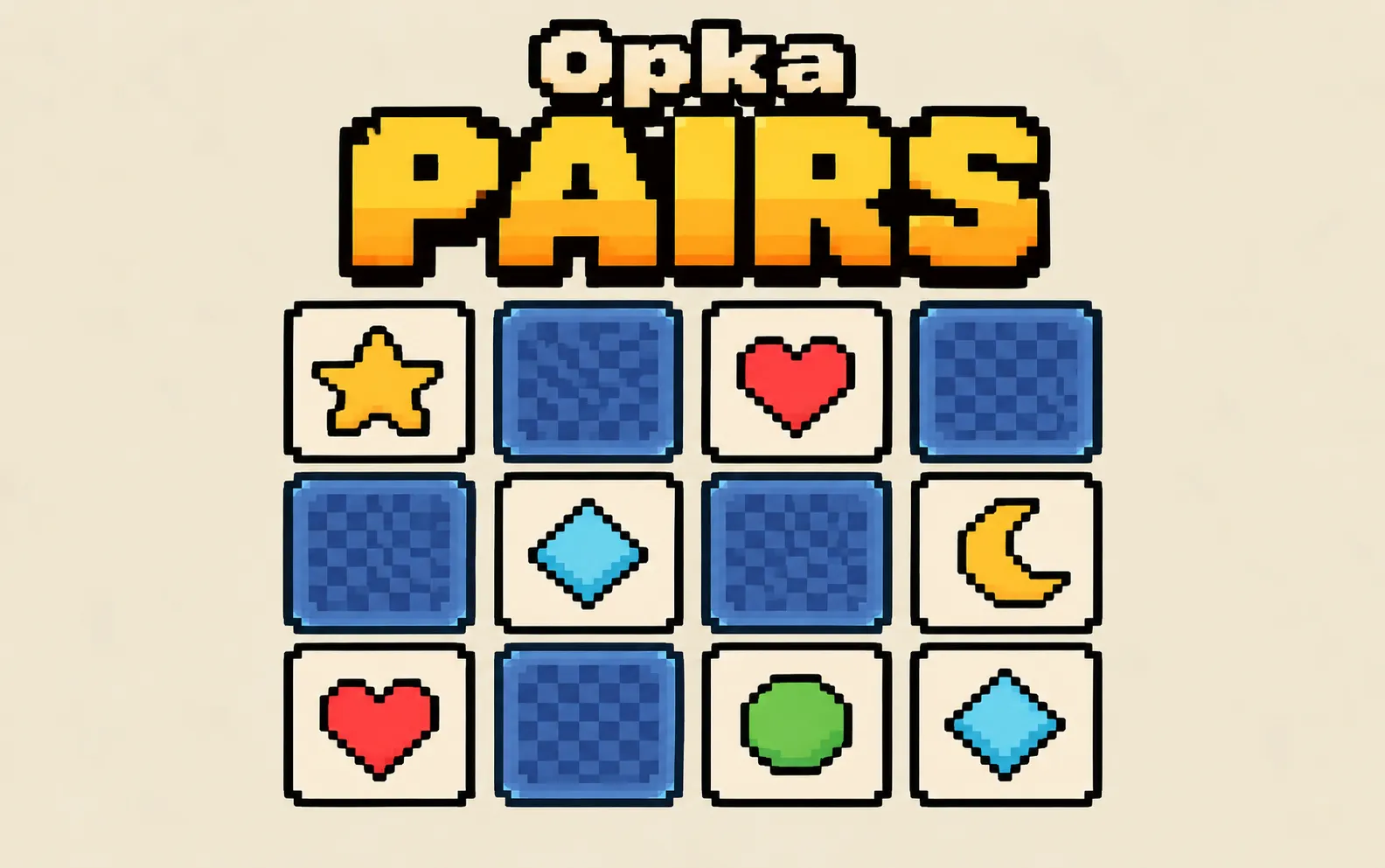
Memory — also called Concentration or Match Pairs — is the simplest game on Opka to explain and one of the harder ones to play well. Every card has a twin. They all start face down. You turn two over: if they match, they stay up, and if they do not, they go back down and you try to remember where they were.
That is the whole game, and it is a pure test of one thing. There is no luck in the usual sense, because the board never changes once it is dealt — every card you fail to find is a card you saw and forgot. A perfect player would clear a 6 by 6 board in eighteen moves without a single wasted flip.
Opka offers a 4 by 4 board of eight pairs for a short round, and a 6 by 6 of eighteen pairs when you want a real one. Both are scored by moves and time, neither of which you have to beat to win — clearing the board is the win, and the numbers are there to measure yourself against.
How Memory is set up
The board is a square grid of cards, all face down. Every face appears exactly twice, and the shuffle is random, so there is nothing to read from the layout before you start.
A 4 by 4 grid holds sixteen cards, which is eight pairs. A 6 by 6 holds thirty-six, which is eighteen. The larger board is more than twice the work, because the number of places you have to keep track of grows faster than the number of pairs.
- 4 by 4: sixteen cards, eight pairs, a two-minute round.
- 6 by 6: thirty-six cards, eighteen pairs, a real test.
- Every face appears exactly twice.
Taking a turn
Turn over any face-down card, then a second. If the two faces match, both stay up for the rest of the game. If they do not, they turn back down after a moment and it is your turn again.
The pause is there so you can read the cards you missed — that is the information the whole game runs on. If you have already seen enough, you do not have to wait it out: turning over your next card clears the mismatched pair immediately and starts a new turn.
Winning, and what the score means
You win by matching every pair. There is no way to lose, no move limit and no clock to beat, so the only question is how efficiently you get there.
A move is one pair of flips, matched or not. The fewest possible is one move per pair — eight on the small board, eighteen on the large one — which means every single turn found a new pair with nothing wasted. That is essentially unreachable on the first few turns of a board you have never seen, since your first flip is always blind.
The timer runs from your first flip. It is worth watching once you are comfortable, because speed and accuracy pull against each other: rushing produces flips you do not properly look at, which is how a board that should take twenty-two moves takes thirty-five.
- Win: every pair matched.
- Moves: one per completed pair of flips, hit or miss.
- Perfect: eight moves on 4 by 4, eighteen on 6 by 6.
How to actually get better at it
The instinct is to remember cards. The better habit is to remember positions — most people recall 'the star was bottom-left' far more reliably than they recall an abstract face on its own, because a position hooks onto the shape of the grid.
Work in a deliberate order rather than flipping at random. Sweeping left to right along a row means the cards you turn over are next to ones you have already seen, which makes them easier to place. Random flipping produces the same information in an order your memory cannot use.
When you turn over a card you have seen before, finish that pair immediately rather than continuing to explore. A known pair is worth more than a new card, because taking it removes two positions from everything you have to keep track of.
- Remember where, not just what.
- Sweep in order rather than flipping at random.
- Take a pair you know before looking for a new one.
- Every matched pair makes the rest of the board easier.
Where the card faces come from
The faces are plain geometric shapes drawn for Opka — circles, triangles, chevrons, rings and so on — each in its own colour from the site's palette. They are original work, so there is no third-party art behind this game and nothing here carries a licence condition.
That is also why they look like shapes rather than pictures of things. A memory board wants faces that are instantly distinguishable at a glance and at a small size, and a set of bold shapes in separate colours does that better than detailed illustrations, which start to blur together on a phone.
Memory and Simon
Opka has two memory games and they test opposite things. Simon plays you a sequence and asks you to repeat it in order — that is working memory, held for seconds, where the order is everything and position is incidental.
Memory asks you to hold a map. Order does not matter at all; what matters is remembering that a particular face was in a particular place, sometimes twenty flips ago. It is spatial rather than sequential, and it rewards patience rather than concentration under pressure.
They also fail differently. In Simon one wrong press ends the run, so a lapse is fatal. In Memory a lapse costs you a move and nothing else — you cannot lose, you can only take longer. If you like one and not the other, that difference is usually why.