
Guide
How to Play 2048
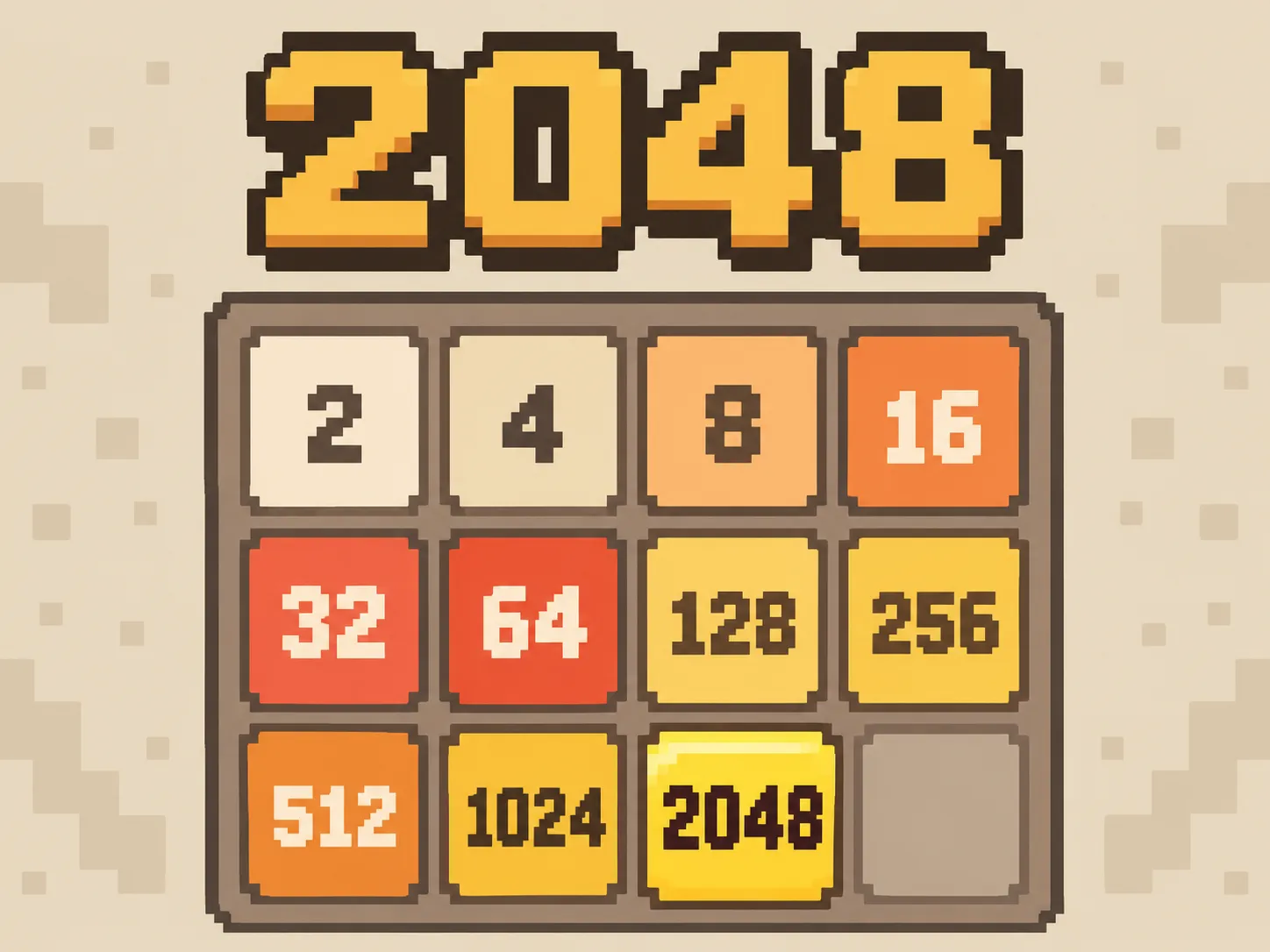
2048 is a compact sliding-tile puzzle where every move changes the whole board. Tiles with the same number merge when they collide, creating a doubled tile and adding that value to your score. The goal is simple to explain but surprisingly tactical: keep combining tiles until you create 2048 without filling the grid.
The pressure comes from the new tile that appears after every successful move. A strong 2048 board usually has a planned corner, a descending chain of large tiles, and enough empty space to absorb bad spawns. Random swiping can work for a while, but the board eventually punishes every broken row and trapped high tile.
How 2048 is set up
The board is a 4 by 4 grid. A new game starts with two numbered tiles, usually 2s with an occasional 4. After every successful slide, one new tile appears in an empty cell.
Legal moves
Slide the board up, right, down, or left. Every tile moves as far as it can in that direction. Matching adjacent tiles merge once per move, so a row of 2, 2, 2, 2 becomes 4, 4 rather than one 8.
How scoring works
Your score is the sum of every tile you create by merging. Combining two 64s adds 128 to the score, so the same board can finish on very different totals depending on how many merges you found along the way.
Sliding without merging scores nothing, and the tile that spawns after a move is never worth points. That is why a patient board, one that keeps setting up larger merges, outscores a board that shuffles constantly.
Win and lose condition
You reach the main goal when any tile becomes 2048. Reaching it does not end the run: you can keep playing toward 4096 and beyond, and your score keeps climbing with every merge.
The game is lost only when the board is full and no slide can move or merge anything.
2048 and Threes
2048 is often mistaken for Threes, released a month earlier in 2014. They look alike and play very differently. In 2048 a swipe sends every tile as far as it can go; in Threes tiles shift only one cell per move, which makes each swipe a much smaller, more deliberate commitment.
The arithmetic differs too. Threes starts by pairing a 1 with a 2 to make 3, after which equal tiles combine into multiples of three. 2048 works purely in powers of two, so every merge doubles. Threes also shows you which tile is coming next, while 2048 keeps the spawn hidden, which is why space management matters more here than prediction.
If you like 2048 for the long planned chains, you will probably enjoy Threes for the tight tactical squeeze, and the other way round.