

Guide
How to Play Backgammon
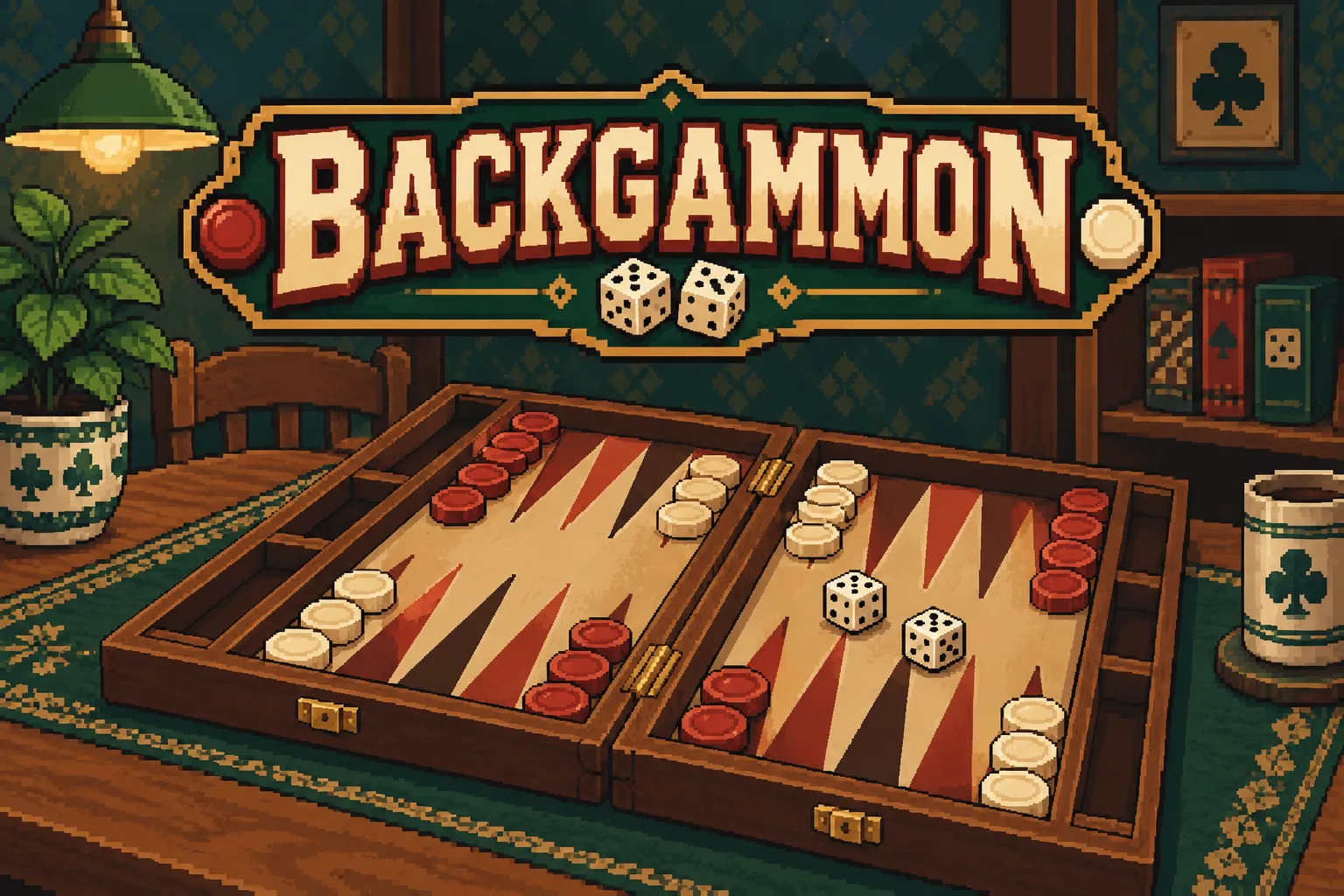
Backgammon is a race with a fight in the middle of it. You and your opponent each have fifteen checkers travelling around the same twenty-four points in opposite directions, and the first to bring all fifteen home and off the board wins. The dice say how far you may move; you decide which checkers move, and that decision is the whole game.
What turns the race into a contest is that a lone checker can be sent back to the start. A single checker on a point is a blot, and if the other player lands on it, it goes to the bar and has to re-enter the board from the far end — losing everything it had travelled. So every move is a choice between speed and safety, and the fastest-looking move is often the one that loses.
It is also the oldest game on this site by a long way; boards recognisably like this one have been dug up from five thousand years ago. On Opka you can play a full game against an AI opponent or pass one device back and forth with somebody else. The engine owns the rules — which moves the dice allow, when a checker may come off — and every turn can be taken back until you commit it.
How a game of Backgammon is set up
The board is twenty-four narrow triangles called points, in four groups of six. Each player has their own home board — the quarter they are trying to reach — and counts the points from there: their 1-point is nearest home and their 24-point is furthest away, deep in the opponent's home board. The two players count in opposite directions, so your 1-point is your opponent's 24-point.
Both sides start with the same spread of fifteen checkers: two on the 24-point, five on the 13-point, three on the 8-point and five on the 6-point. That works out to 167 pips of travelling each, so the game begins dead level.
To decide who starts, each player rolls a single die and the higher number goes first, using both dice as their opening roll. Ties are rerolled, which is why an opening roll is never a double.
- Twenty-four points, fifteen checkers each, moving in opposite directions.
- Two on the 24, five on the 13, three on the 8, five on the 6.
- One die each to start, higher goes first, ties rerolled.
Moving: two dice, two moves
Roll two dice and you get two moves — one of each number. You can play both with the same checker or split them between two, but each die is a separate hop, and a checker has to be able to land legally at the end of each one.
A double is worth four moves of that number rather than two, which is why rolling double sixes can change a game in one turn.
You may land on any point that is empty, holds your own checkers, or holds exactly one of your opponent's. What you cannot do is land on a point with two or more opposing checkers — those points are closed to you, and closing points in front of your opponent is one of the main ways to win.
You must play as much of your roll as the position allows. If both numbers can be played, you have to play both, even when playing only one would suit you better. If only one can be played, you play that one — and if either would work alone but not both together, the rules say you must play the higher.
- One move per die; a double gives four.
- A point with two or more enemy checkers is closed to you.
- You must use as much of the roll as you legally can.
Hitting and the bar
A point with exactly one checker on it is a blot. Land on an opposing blot and you hit it: that checker comes off the board and goes on the bar, the ridge down the middle.
A checker on the bar has to come back in before its owner may do anything else. It re-enters in the opponent's home board on the point matching a die — a one brings it in on the 24-point, a six on the 19-point — and only if that point is not closed. If every entry point is blocked, the whole turn is forfeited, and a player can sit on the bar for several turns while the game runs away from them.
Being hit is expensive in proportion to how far the checker had come. A blot one point from home loses almost the entire journey; a blot that has barely left the start loses almost nothing. That is the arithmetic behind most decisions in the game: not whether a blot is risky, but how much it would cost if the risk came in.
- A blot is a single checker, and it can be hit.
- A hit checker goes to the bar and re-enters from the far end.
- Nothing else may move until the bar is clear.
Making points and blocking
Two checkers on a point make it yours: it is safe from being hit and closed to your opponent. Several of them in a row is a wall your opponent's checkers cannot cross, and if you can close six consecutive points you have a prime that nothing gets past at all.
The most valuable points are the ones just in front of where your opponent needs to go. Your 5-point and your bar point — the 7 — are the two most fought over, because they sit exactly where the checkers coming out of your home board want to land.
The other side of that coin is the anchor. If you have checkers back in your opponent's home board, keeping two of them together on a point rather than leaving them as blots gives you a safe place to sit while you wait for a shot at their blots.
- Two checkers make a point: safe from hits, closed to the opponent.
- The 5-point and the bar point are the most valuable to hold.
- Two checkers back in enemy territory form an anchor, not a liability.
Bearing off
Once all fifteen of your checkers are in your home board — your 1-point through 6-point — you can start taking them off the board. This is bearing off, and it is what actually wins the game.
A die takes a checker off the point matching that number: a four bears off from the 4-point. A number larger than any point you still occupy bears off from your highest occupied point, so a six lifts a checker off the 5-point once the 6-point is empty. What you cannot do is use a large number on a low point while a higher one is still occupied — a five may not take a checker off your 3-point while a checker sits on your 5-point. You have to play it up there or move inside the board instead.
A number smaller than your highest point is simply an ordinary move within the home board. And if a checker gets hit while you are bearing off — which can happen if your opponent still has an anchor back there — it goes to the bar and everything stops until it comes all the way round again.
- All fifteen checkers home before any can come off.
- An exact number lifts a checker off that point.
- A bigger number only bears off from your highest occupied point.
Winning: gammon and backgammon
Bear off all fifteen checkers and you win. How much you win depends on how far behind your opponent was when you finished.
If they have borne off at least one checker, it is an ordinary win worth a single point. If they have not borne off any, it is a gammon and worth double. And if they have not borne off any and still have a checker on the bar or sitting in your home board, it is a backgammon and worth triple — caught out at the wrong end of the board with nowhere to go.
This is why a losing player fights to get one checker off rather than resigning: the difference between losing one point and losing two is a single checker.
- Single win: the loser has borne off at least one checker.
- Gammon, worth double: the loser has borne off none.
- Backgammon, worth triple: none off, and still on the bar or in your home board.
The pip count
The pip count is the number of pips you would need to bring every checker home, and it is the plainest way to know where you stand. Add up, for each checker, how far it still has to travel; a checker on the bar counts twenty-five. Both players start on 167.
The count matters because it tells you which game you are playing. If you are ahead in the race, you want to run — take the safe, fast moves, avoid contact, and get home before anything can go wrong. If you are behind, running loses by definition, so you want contact: keep an anchor, stay back, and wait for a shot.
That single decision, race or fight, explains most backgammon mistakes. Players who are behind keep playing safe and lose the race they were never going to win, and players who are ahead keep hitting when they should have been running for home.
- Pip count: total pips every checker still owes; bar counts 25.
- Ahead in the race, run and avoid contact.
- Behind in the race, keep an anchor and play for a shot.
Backgammon, Checkers and Chess
Backgammon is often shelved next to Checkers and Chess as one of the old board games, and it plays nothing like either of them. Chess and Checkers are games of complete information with no randomness: the position is all there is, both players can see everything, and a better player wins essentially always.
Backgammon has dice, so it has luck, and that changes what skill even means. A stronger player will not win every game — the dice will beat them sometimes — but they will win a long series comfortably, because their edge shows up in hundreds of small decisions about which checker to move rather than in finding one winning line.
The other real difference is the direction of play. In Chess and Checkers both sides move across the same board toward each other. In Backgammon the two players travel in opposite directions around the same track, so your safest ground is your opponent's most dangerous, and a point that is a fortress for you is an obstacle for them.
- Chess and Checkers have no luck; Backgammon has dice.
- Skill in Backgammon shows over a series, not in one game.
- The players move in opposite directions around one track.