Guide
How to Play Checkers
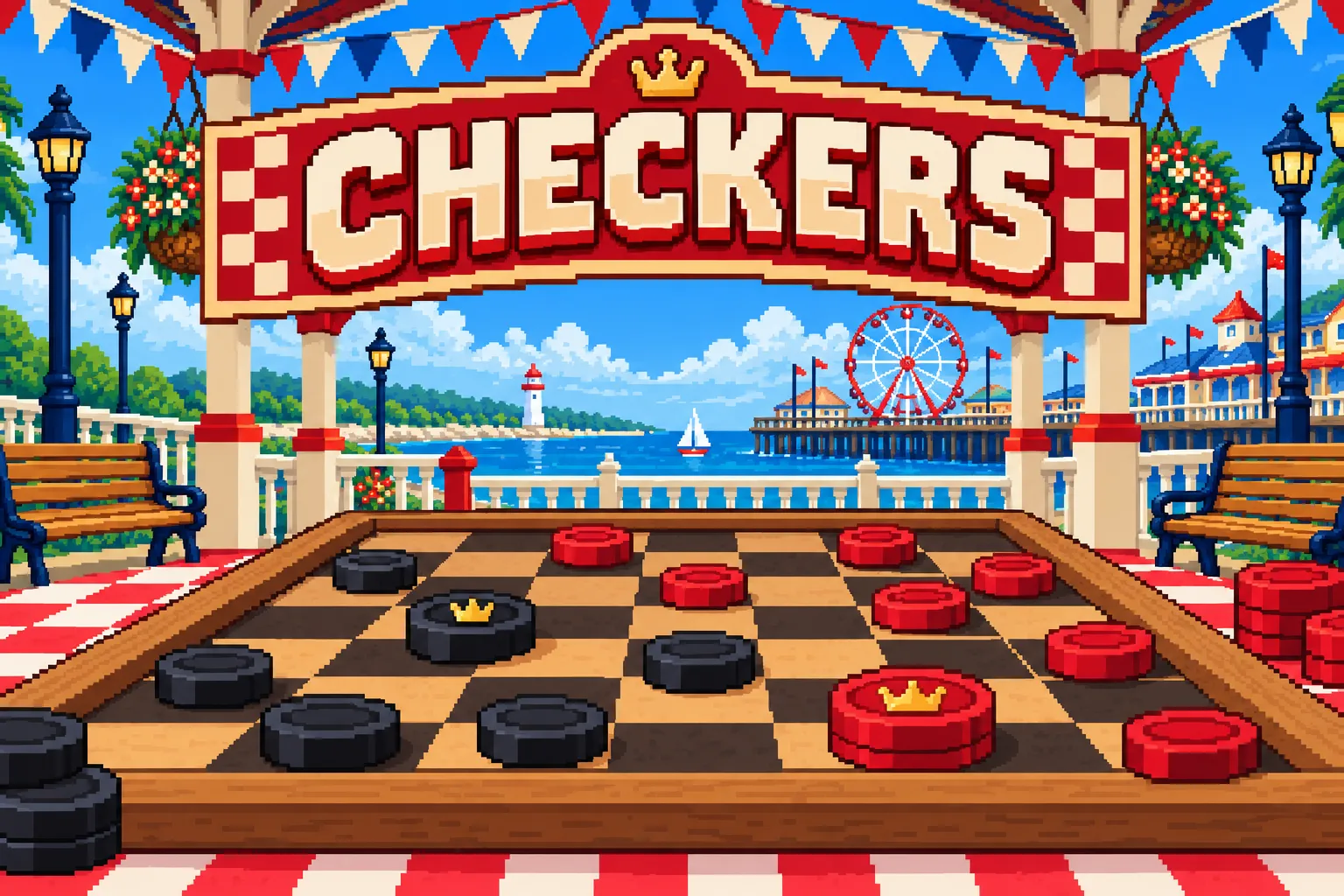
Checkers — English draughts, or American checkers — is played by two people on the dark squares of an ordinary chessboard. Each side starts with twelve pieces on the three rows nearest them, everything moves diagonally, and you win by taking all of your opponent's pieces or leaving them with no move at all.
It looks simple enough to learn in a minute, and it is. What makes it a game is a single rule that beginners often do not know: if you can capture, you must. You do not get to decline a jump because it looks awkward, which means a large part of good play is arranging positions where your opponent's compulsory capture is the move that loses them a piece.
The other half is crowning. A man that reaches the far row becomes a king and can then move and capture backward as well as forward. Kings are much stronger, and most games turn on who gets one first — which is why the back row is worth holding rather than advancing.
On Opka you play White against an AI opponent at three strengths, or hand the device back and forth in hot-seat. The engine owns the rules: it will not offer you a quiet move while a capture exists, and it works out multi-jump chains for you so you only have to pick which route to take.
Setting up and moving
Twelve pieces each, on the dark squares of the three rows nearest you. A dark square sits in each player's near-left corner, which is how you know the board is the right way round. Everything happens on the dark squares; the light ones are never used.
A man moves one square diagonally forward onto an empty square. It cannot move sideways, straight ahead, or backward, and it cannot move onto an occupied square. White moves first.
That is the whole of ordinary movement. Every other rule in checkers is about capturing.
- Twelve pieces a side, dark squares, first three rows.
- Men move one square diagonally forward only.
- White moves first.
Why jumps are compulsory
To capture, you jump: your piece hops over an adjacent enemy piece and lands on the empty square directly beyond it, in a straight diagonal line. The jumped piece comes off the board.
If a capture is available anywhere on the board, you have to make one. Not necessarily the biggest one and not necessarily with a particular piece — but you cannot make a quiet move instead. This is the rule that turns checkers from a race into a game of traps, because a forced capture is a move your opponent chose for you.
If a jump lands your piece somewhere another jump is available, you must keep jumping with that same piece until it has no more. A double or triple jump is one turn, not two. Where several different chains exist, you pick which one — English draughts has no rule requiring you to take the most pieces.
- A capture available anywhere makes every quiet move illegal.
- Chains continue until the jumping piece has no further jump.
- You choose between chains; there is no must-take-most rule.
Kings, and the rule about crowning mid-jump
A man that finishes its move on the opponent's back row is crowned and becomes a king. Kings move and capture diagonally in all four directions instead of only forward, which roughly doubles what a piece can threaten.
There is one wrinkle worth knowing, because it catches people out and because it is a real strategic feature rather than a technicality. If a man reaches the king row as part of a jump, the move stops there. It is crowned, but it does not continue jumping as a king in the same turn — even if another capture is sitting right there. It has to wait until your next turn.
In English draughts a king moves exactly one square, like a man. It does not slide any distance along the diagonal. That is the biggest single difference from international draughts, and it is why kings here are strong but not overwhelming.
- Crowned on reaching the far row; kings move and capture backward.
- A jump that crowns ends the turn, even if more jumps are available.
- Kings step one square — they do not fly.
How the game ends
You win by taking all of your opponent's pieces, or by leaving them with no legal move. That second condition is a genuine win, not a draw: a player who still has pieces but cannot move any of them has lost. This is unlike chess, where the same situation is a stalemate and shared.
Draws happen when neither side can make progress — typically a couple of kings circling each other with nothing to attack. Opka uses a simple counter for this: forty plies without a capture or a crowning and the game is drawn.
Undo is unlimited. Against the AI, taking a move back also takes back its reply, so you return to the position you actually chose from rather than one move deeper.
Not the same as international draughts or Chinese Checkers
Three different games get called some version of "checkers", and it is worth being clear which this is. This is English draughts: an 8x8 board, twelve pieces a side, and kings that step one square.
International draughts is played on a 10x10 board with twenty pieces a side, and its kings fly — they slide any distance along a diagonal and can capture from far away. It also requires you to take the maximum number of pieces available. Those changes make it a substantially deeper game, and a position from one is not a position from the other.
Chinese Checkers is not a draughts game at all. It is played on a six-pointed star with marbles, there is no capturing whatsoever, and the goal is to hop all of your pieces across to the opposite point. It shares a word and nothing else.
- English draughts: 8x8, twelve a side, kings step one square.
- International draughts: 10x10, twenty a side, flying kings, must take the most.
- Chinese Checkers: star-shaped board, marbles, no capturing at all.