
Guide
How to Play Blackjack
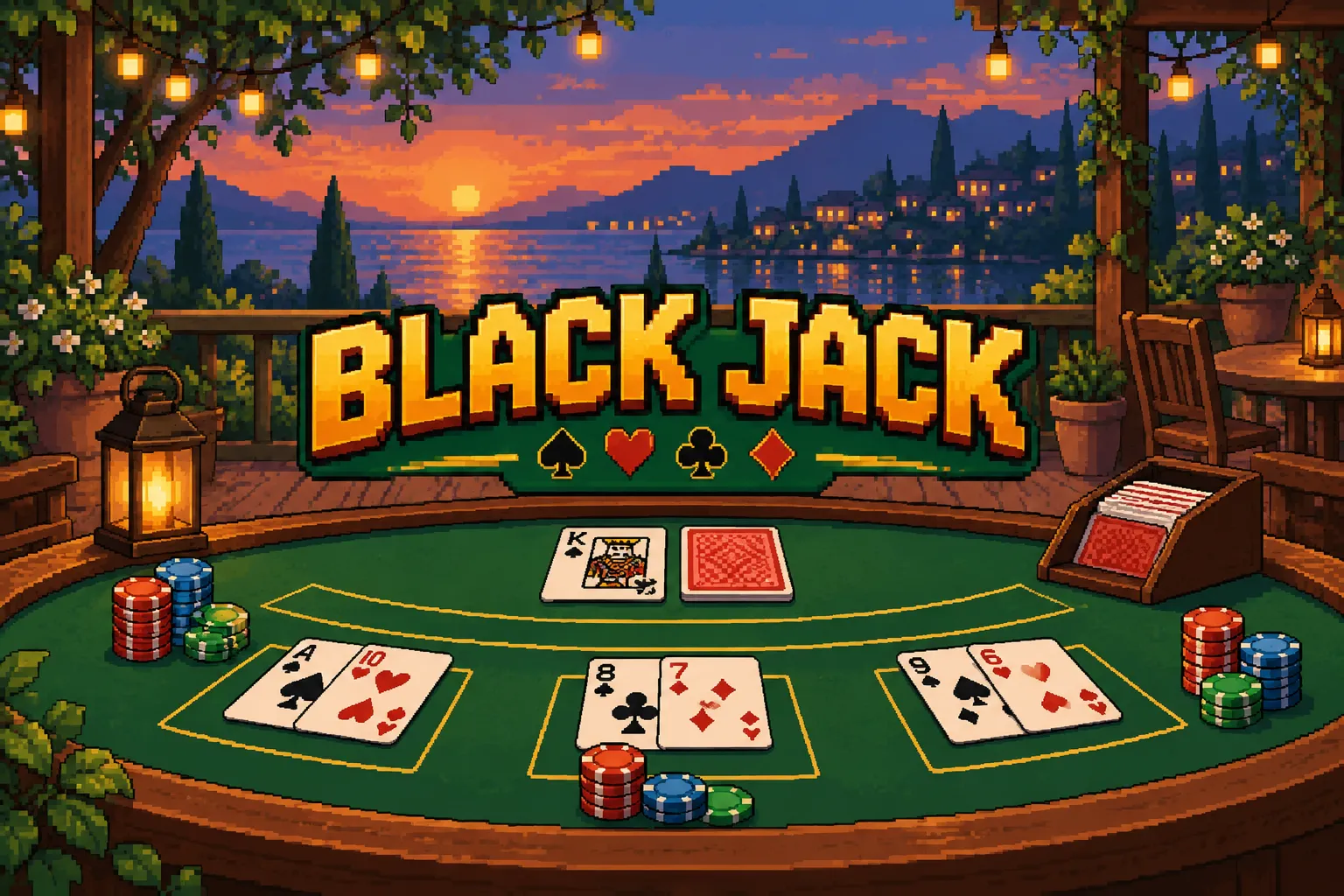
Blackjack is a race to twenty-one that you are not allowed to overshoot. You and the dealer each start with two cards, you draw as many more as you like, and whoever finishes closer to twenty-one without passing it wins the hand. Going over is called busting, and it loses immediately — before the dealer has played at all, which is where the house gets most of its edge.
Opka's table is play money. There is no deposit, no cashier, and no way to wager anything real: the chip stack is a number in your browser that resets when you want it to. This is the game as a decision puzzle, which is the interesting part of it anyway.
The rules here are the common modern ones: six decks in the shoe, blackjack pays 3:2, you may double any two cards and split once, insurance is offered when the dealer shows an Ace, and the dealer hits soft seventeen. That last one is worth knowing before you sit down, because it is slightly worse for you than the older rule and it changes a couple of decisions.
How a hand is dealt
You place a bet, then receive two cards face up. The dealer takes two as well, one face up and one face down — the upcard and the hole card. The upcard is the only thing you know about the dealer's hand, and every decision you make is really a decision about that one card.
Cards are worth their number. Jacks, Queens and Kings are worth ten. An Ace is worth eleven unless that would bust you, in which case it drops to one, and it can drop later in the hand as the cards arrive.
- Two to ten: face value.
- Jack, Queen, King: ten.
- Ace: eleven, or one if eleven would bust the hand.
Soft hands and hard hands
A hand is soft when it holds an Ace still being counted as eleven. Ace and six is a soft seventeen: you cannot bust it by drawing, because the Ace drops to one if the new card is too big. The same two cards after drawing a King are a hard seventeen, because the Ace has already been demoted and there is nowhere left to go.
This is the single most useful idea in the game. Soft hands are safe to draw to and are played far more aggressively than their total suggests, which is why a soft eighteen is often a hit and a hard eighteen almost never is.
What you can do on your turn
Hit takes another card, as many times as you like until you stand or bust. Stand ends your turn and leaves your total where it is.
Double doubles your bet and takes exactly one more card, then ends the hand whatever that card was. It is offered on your first two cards only, and it is how you press an advantage rather than a way to escape a bad total.
Split is offered when your two cards are the same value, and turns them into two hands with a second bet matching the first. Opka allows one split per round, so two hands is the maximum. Split Aces get exactly one card each and no further action — a twenty-one made that way is an ordinary twenty-one, not a blackjack, and pays even money rather than 3:2.
- Hit: another card, repeatable.
- Stand: end the turn.
- Double: twice the bet, exactly one card, hand over.
- Split: one per round, two hands; split Aces take one card each.
Blackjack, and why it pays more
A blackjack — sometimes called a natural — is an Ace with any ten-value card on the first two cards. It pays 3:2 rather than even money, so a hundred-chip bet returns a hundred and fifty in winnings.
The two-card part matters. A twenty-one assembled from three or more cards is a good hand and beats everything except a blackjack, but it pays 1:1 like any other win. If both you and the dealer have a natural, the hand is a push and your bet comes back.
Why the dealer hits soft 17, and what it costs you
The dealer does not make decisions. They draw to sixteen, stand on seventeen, and on this table they also hit a soft seventeen — an Ace and a six, or any total of seventeen with an Ace still counted high. The choice is written into the rules of the table rather than left to the person dealing.
Opka uses the hit-soft-17 rule because it is the modern casino default, particularly on six-deck shoes. It is worse for the player than standing on soft seventeen, by roughly two tenths of a percent of each bet. That sounds like nothing and mostly is, but it is a real difference and it is the kind of thing a table should tell you rather than let you find out.
Practically, it means the dealer busts a little more often and also makes strong hands a little more often, because a soft seventeen can improve. The main effect on your play is that you should be slightly more willing to double against a dealer Ace.
Insurance and even money
When the dealer's upcard is an Ace, you are offered insurance: a side bet of half your stake that the dealer has a blackjack. It pays 2:1 if they do, and is simply lost if they do not.
Insurance is a bad bet in almost every circumstance, because the dealer completes a blackjack less often than 2:1 odds require. It is not really insurance at all — it is a separate wager on the hole card, dressed up as protection.
The one case worth understanding is even money. If you have a blackjack and the dealer shows an Ace, taking insurance guarantees you exactly your stake in profit: if the dealer has it your hand pushes and the side bet pays, and if they do not, your 3:2 covers the lost side bet. It is a real equivalence rather than a trick, and it is why tables offer to settle that situation immediately. Whether it is the right choice is a different question — it trades a larger average return for a certain one.
Where to start with basic strategy
Basic strategy is the set of plays that gives up the least to the house, worked out by playing every situation against every dealer upcard. It is a table rather than a philosophy, and nobody is expected to derive it at the table.
A handful of rules carry most of the value. Always split Aces and eights, never split tens or fives. Stand on hard seventeen and above. Hit hard totals of eleven or less without thinking about it, because you cannot bust. Double on eleven, and on ten against anything but a ten or an Ace. Against a dealer showing two through six, stand on twelve through sixteen and let them draw into a bust; against seven or higher, draw to at least seventeen.
None of this makes the game favourable. Played perfectly, a six-deck table like this one still keeps about half a percent of everything wagered. That is the honest shape of the game, and it is another reason the chips here are not real.
- Always split Aces and eights; never split tens or fives.
- Stand on hard seventeen or more.
- Double on eleven; double ten against two through nine.
- Against a dealer two through six, stand on twelve to sixteen.
- Against a dealer seven or higher, draw to seventeen.
This is a play-money table
There is no real-money wagering on Opka and no route to any. The chip stack is local to your browser, it is not connected to an account balance, nothing is bought and nothing is paid out. Blackjack is here as a game of decisions, the same way Chess and Backgammon are.
If gambling is something you would rather not be around, this page is a reasonable one to skip — the table is a faithful model of a casino game even though the chips are not real. Free help is available in most countries; in the UK, GamCare runs a confidential helpline on 0808 8020 133.
Blackjack and the other card games here
Blackjack is not a trick-taking game, which makes it the odd one out among Opka's card titles. Hearts and Spades are about what other players do with the cards you cannot see, and reading the table is most of the skill. Blackjack has no other players at all — the dealer follows a script with no choices in it, so you are playing against a fixed procedure rather than an opponent.
That makes it closer to Solitaire than to Hearts, in that the correct play is fully determined by the position. The difference is that Solitaire hides information you could have used, while Blackjack hides exactly one card and lets you reason about it from the upcard. Nothing here can be bluffed and nothing can be signalled.