





Guide
How to Play FreeCell Solitaire
FreeCell is the open-information member of the Solitaire family. Every card starts face up, so the challenge is not guessing what is hidden. It is planning how to untangle the tableau using four temporary free cells and the empty columns you create.
That makes FreeCell feel more strategic than luck-driven. A messy layout can often be solved if you preserve enough movement space, move cards in the right order, and avoid filling every free cell just because it is available.
How FreeCell is set up
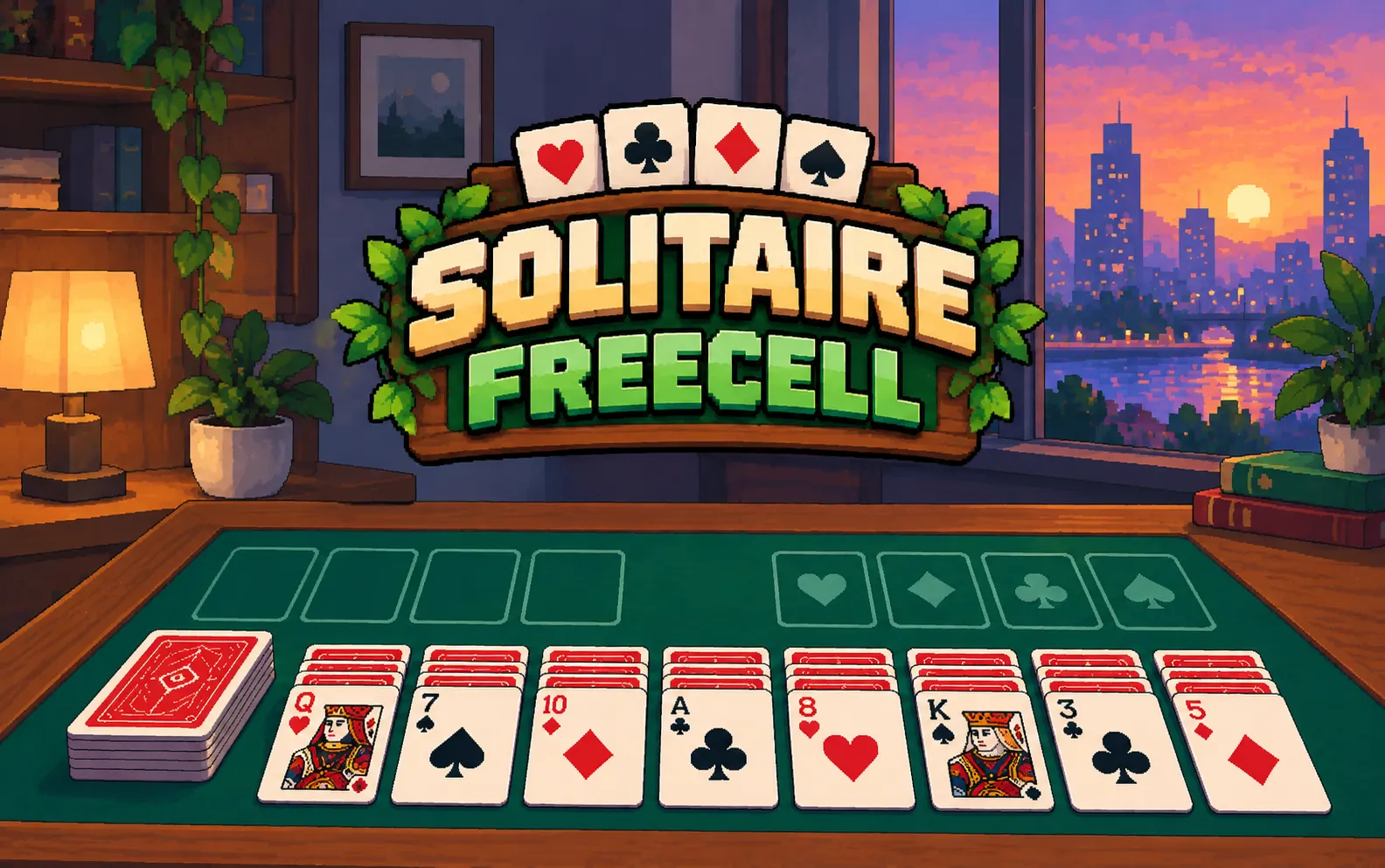
FreeCell uses one standard 52-card deck. All cards are dealt face up into eight tableau columns. Four columns start with seven cards, and the other four start with six cards.
Above the tableau are four free cells and four foundations. Free cells hold one card each as temporary storage. Foundations are built by suit from Ace to King, just like in Klondike.
- Tableau: eight face-up columns where cards are rearranged.
- Free cells: four single-card spaces used as temporary parking.
- Foundations: four suit piles built upward from Ace to King.
- Empty columns: powerful temporary lanes that let longer sequences move.
Legal moves
Tableau columns build downward in alternating colors. A black 9 can receive a red 8, and a red Queen can receive a black Jack. A single card can move to another valid tableau card, to an empty column, to a free cell, or to its foundation when it is the next card of that suit.
A run of cards can move together when it is already in descending alternating-color order and there is enough temporary space to make that move possible. Empty free cells and empty tableau columns increase how many cards can travel as one sequence.
Why free cells are valuable
The four free cells look like storage, but they are really your movement budget. Each occupied free cell reduces the number of cards you can maneuver. Filling all four too early often turns a solvable board into a cramped one.
An empty tableau column is usually even stronger than an empty free cell because it can hold a whole descending sequence after it is built. Good FreeCell play often means creating an empty column, using it to rotate a buried card loose, then rebuilding the tableau without wasting every free cell.
How to win
The round is won when all 52 cards reach the foundations. Because the entire deal is visible, the strongest moves usually serve a clear purpose: release an Ace or low card, create an empty column, or free a blocking card that controls several others.
Do not rush high cards to the foundations if they still help organize the tableau. Low foundation moves are usually safe, but a higher card can sometimes be useful as a landing spot before it leaves the board.