
Guide
How to Play Gin Rummy
Gin Rummy is a two-player game about tidying up. You are dealt ten cards, and your job is to arrange them into melds — three or four of the same rank, or three or more in a row in one suit — while getting rid of everything that does not fit. The cards that never fit are your deadwood, and at the end of a round they are what you are charged for.
Every turn is the same small decision twice over: take the face-up card or the unknown one from the stock, then choose which card to let go. That is the whole game. What makes it hard is that the card you throw goes face up where your opponent can take it, so every discard is a choice between what helps your hand and what helps theirs.
A round does not have to be played out. As soon as your deadwood is down to ten points or fewer you may knock, ending the round on the spot and scoring the gap between your deadwood and your opponent's. On Opka you play one seat against an AI opponent, the engine owns the rules — what melds, what your deadwood is, whether you may knock — and the match runs to 100 points.
How a hand of Gin Rummy is dealt
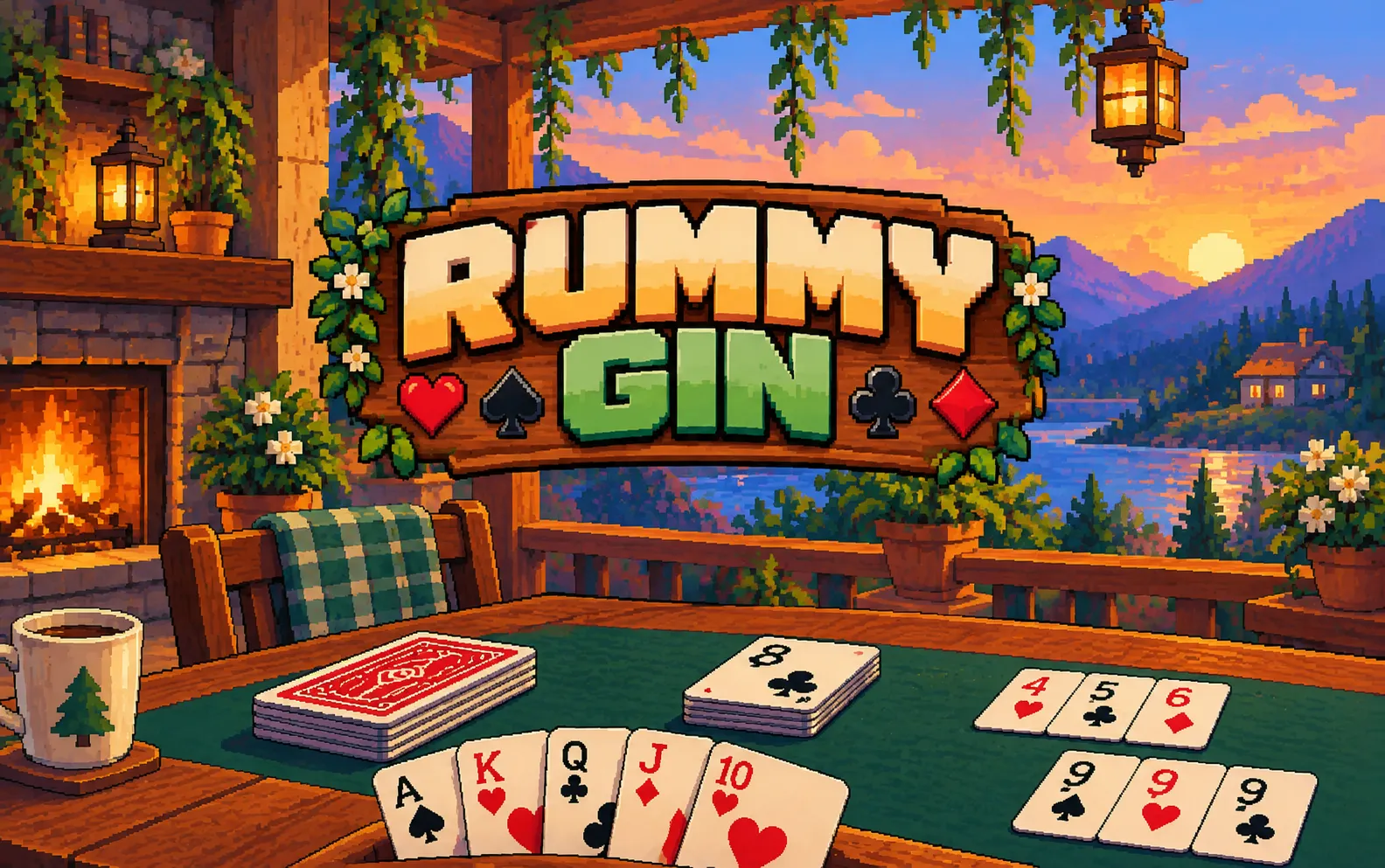
Two players, one 52-card deck, ten cards each. The next card is turned face up to start the discard pile, and the remaining thirty-one become the stock. The non-dealer plays first, and the deal alternates every round.
There is no trump suit, no bidding and no partner. Twenty-one of the fifty-two cards are visible or held at the start, which means most of the deck is still unknown — and the discard pile is the only place you ever get to watch it being revealed.
- Ten cards each, one card face up, thirty-one in the stock.
- The non-dealer goes first; the deal changes hands each round.
- The ace is low: it is worth one point, and A-2-3 is a run.
Your turn: draw one, discard one
On your turn you take exactly one card and then let exactly one go, so your hand is eleven cards for a moment and ten again by the end. You may take the face-up card on the discard pile, or the top of the stock without seeing it first.
The one thing you may not do is take the face-up card and immediately put it back. That would be a free turn and a free look at nothing, so the rules forbid it — you have to keep the card you took until at least your next turn, and discard something else.
Taking from the pile tells your opponent something real, because they watched you do it. Taking from the stock tells them nothing. That is why a good player takes the face-up card only when it genuinely joins a meld, and otherwise draws blind.
- One card in, one card out, every turn.
- You may not discard the card you just took from the pile.
- Drawing from the pile is public; drawing from the stock is not.
Melds and deadwood
A meld is either a set — three or four cards of the same rank, like three eights — or a run, three or more consecutive cards in a single suit, like the five, six and seven of clubs. A run does not wrap around: the ace sits below the two, so A-2-3 is a run and Q-K-A is not.
Everything not in a meld is deadwood, and deadwood is counted in points. The ace is one, the numbered cards are worth their number, and the jack, queen and king are ten each. So a hand full of low cards is a cheap hand to be caught with, and one full of court cards is expensive.
A card can only be in one meld at a time, which is where the thinking comes in. If you hold the seven of clubs alongside three other sevens and the eight and nine of clubs, you cannot use it twice — and putting it in the run rather than the set is what lets the other three sevens still meld together.
- Sets are three or four of a rank; runs are three or more in suit.
- Ace 1, numbers face value, jack, queen and king 10 each.
- Every card belongs to at most one meld.
Knocking
When your deadwood is ten points or fewer you may end the round by knocking. You knock as part of your discard: you draw as usual, then put your last card down and stop the round rather than passing the turn on.
Whether you may knock depends on the card you throw, not just on the hand you hold. Eleven cards with twenty points of deadwood might come down to exactly ten if you throw the king and nothing else, in which case the king is the only discard that can knock.
Knocking early is not obviously right. A thin knock — ten deadwood, on a turn when your opponent has barely drawn — can still win the round, but it gives them the chance to turn it around, which is what the next section is about.
- Knock at ten points of deadwood or fewer.
- The knock happens on your discard, not before it.
- Some discards let you knock and others do not.
Gin
Gin is a hand with no deadwood at all: all ten cards melded, nothing left over. It scores a flat 25-point bonus plus every point in your opponent's hand.
The bonus is not the only reason to want it. Going gin also takes away your opponent's right to lay off, so instead of shedding their loose cards onto your melds they are charged for all of them. Against a plain knock a hand with fifteen points of deadwood might pay four; against gin it pays fifteen.
Gin also cannot be undercut. An undercut needs the defender to finish at or below the knocker, and nothing is below zero, so a gin hand is the only knock that carries no risk at all.
- Zero deadwood: 25 points plus the opponent's whole hand.
- No laying off is allowed against gin.
- A gin hand can never be undercut.
Laying off and the undercut
When somebody knocks with deadwood left over, they lay their melds face up, and the defender gets to add their own loose cards to them. If the knocker put down the five, six and seven of diamonds, the defender's eight of diamonds goes onto the end of it and stops being deadwood. This is laying off, and it can chain: once the eight is down, the nine can follow.
Then the two deadwood counts are compared. If the defender is still higher, the knocker scores the difference. But if laying off has brought the defender level with the knocker or below them, the knock has backfired: the defender scores the difference instead, plus a 25-point bonus of their own. That is an undercut.
This is why a thin knock is a gamble. Knock on eight points against a defender holding sixteen and you expect eight points — but if eight of those sixteen slide onto your own melds, they finish level with you and take 25 instead. The melds you lay down are the ladder your opponent climbs.
- The defender may add loose cards to the knocker's melds only.
- Laying off chains: one card down can make room for the next.
- Level or lower after laying off means the defender scores, plus 25.
Scoring, and what a round is worth
Only one player scores in a round. A plain knock pays the knocker the difference between the two deadwood counts after laying off. Gin pays 25 plus the defender's whole hand. An undercut pays the defender the difference plus 25.
Because gin and the undercut both carry a 25-point bonus, a round is rarely worth nothing and occasionally worth fifty or more. Typical rounds land somewhere in the teens, and a match to 100 usually takes ten or twelve of them.
One round in twenty or so ends without a score at all. If the stock runs down to two cards and neither player has knocked, the hand is dead: nobody scores, and the cards are shuffled and dealt again with the deal passing over. It is not a bug, it is the game admitting that there is nothing left to draw.
- Knock: the difference in deadwood, after laying off.
- Gin: 25 plus the defender's whole hand, with no laying off.
- Undercut: the difference plus 25, to the defender.
- First to 100 points wins the match.
Gin Rummy, Oklahoma Gin, and 500 Rummy
Gin Rummy is one member of a large family, and the differences are smaller than the shared name suggests. This table plays standard Gin: knock at ten, gin worth 25, undercut worth 25, first to 100.
Oklahoma Gin is the same game with one rule changed, and it is a rule that changes everything. The card turned up at the start of the round sets the knocking limit for that round, so if a four is turned up you may not knock above four deadwood, and a turned-up ace means gin or nothing. Rounds get longer and thin knocks disappear.
500 Rummy is a different game wearing a similar hat. Melds go on the table face up as you make them, you can add to your opponent's melds as well as your own, the whole discard pile is available rather than just the top card, and you score for the cards you meld rather than only for the deadwood you avoid. It plays with more than two people and it rewards laying cards down early, where Gin rewards keeping everything hidden until the end.
- Standard Gin: knock at ten, play to 100.
- Oklahoma Gin: the upcard sets the round's knock limit.
- 500 Rummy: melds go down as you go, and scoring is for melds.