

Guide
How to Play Connect Four
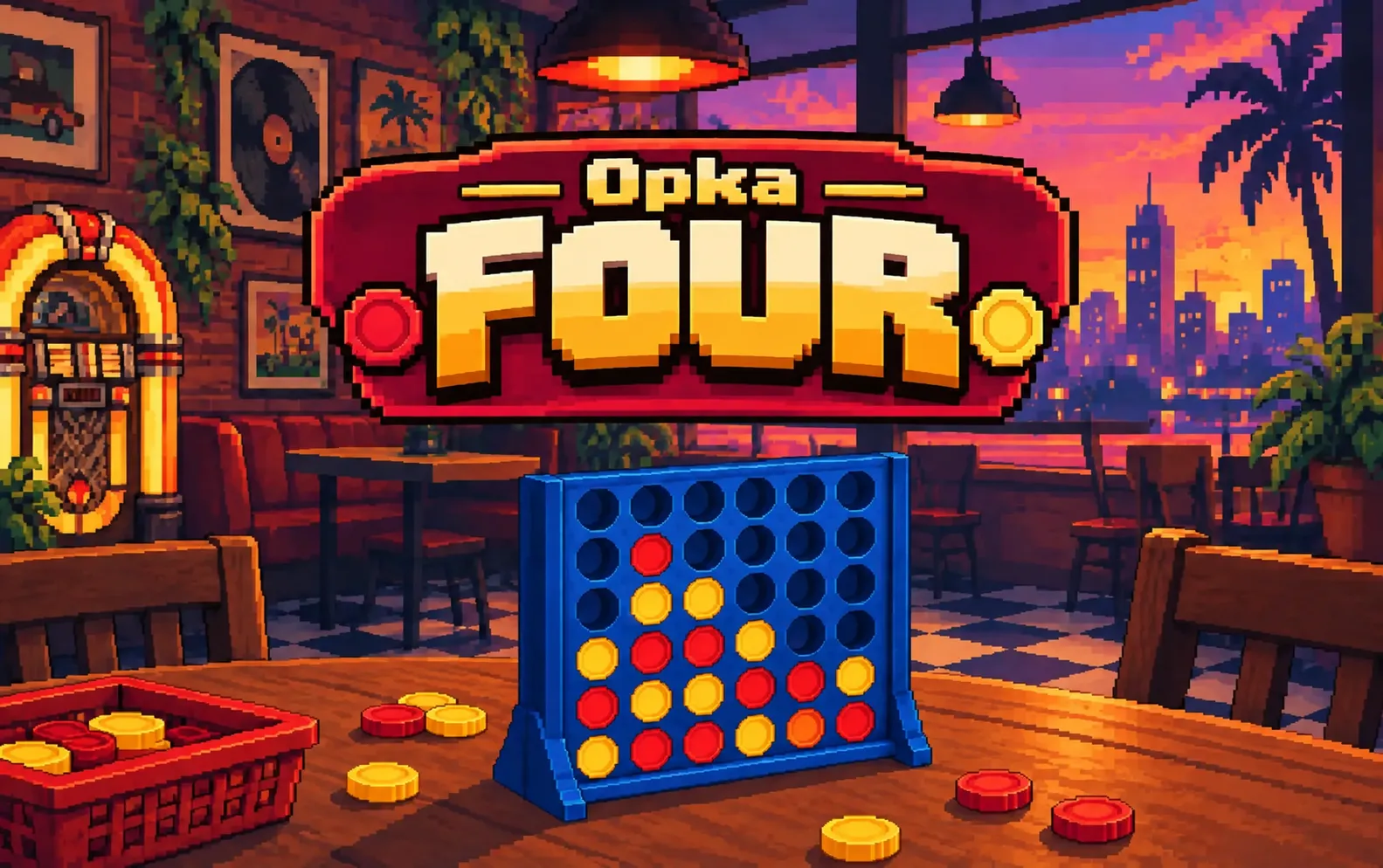
Connect Four is a four-in-a-row game played on a standing grid of seven columns and six rows. Players alternate dropping discs into a column, each disc falls to the lowest empty cell in that column, and the first player to line up four of their own colour horizontally, vertically, or diagonally wins. If all forty-two cells fill with no line, the game is a draw.
The rule that makes it a real strategy game is gravity. You choose a column, never a cell, so every disc you place also decides which cell your opponent can reach next. A square you want may be unreachable for several turns, and a square you would rather not open may be handed over the moment you play beneath it.
On Opka you can play solo against Opka Bot or hand the device back and forth in two player mode. Solo has three levels: Easy drops into any open column, Medium takes every win and blocks every immediate threat, and Strong searches several moves ahead and plans double threats rather than answering the last one. You can also choose whether you take red or yellow, and red always drops first.
How Connect Four is set up
The grid stands upright with seven columns and six rows, giving forty-two cells. It starts completely empty, and each player has twenty-one discs of their own colour, which is exactly enough to fill their half of the board if the game goes the distance.
Red drops first by default, then yellow, and the colours alternate until someone connects four or the grid fills. Because every disc is identical, the position is nothing more than the pattern of colours on the grid and whose turn it is.
- Seven columns: the only choice you make on a turn.
- Six rows: how far a column can stack before it is closed.
- Twenty-one discs each: the board fills exactly if nobody connects four.
Legal moves
A move is a column, not a cell. The disc falls to the lowest empty cell in the column you choose, so the landing square is decided by what is already there, not by you. A column holding six discs is full and cannot be chosen.
Discs are never moved, removed, or replaced once they land, and nothing happens between turns. The only illegal moves are dropping into a full column and playing after the game has already ended.
Win and draw condition
Four of your discs in an unbroken line wins immediately, and the line can run horizontally, vertically, or along either diagonal. A win ends the game on the spot, even if the board still has empty cells and even if the same drop happens to complete two lines at once.
If the forty-second disc lands with no four-in-a-row anywhere, the game is a draw. Draws are much rarer than they are in Tic-Tac-Toe, because the board is large enough that one side almost always builds a threat the other cannot answer.
Why the centre column decides games
Not every column is worth the same. A cell in the centre column belongs to more possible four-in-a-row lines than a cell anywhere else, and the two outer columns belong to the fewest. Discs in the middle therefore do more work: they contribute to more of your own lines and sit in the way of more of your opponent's.
That imbalance is strong enough to decide the whole game. Connect Four is a solved game, worked out independently by James Dow Allen and Victor Allis in 1988, and the result is that the player who moves first can force a win by opening in the centre column. Opening in one of the two columns beside the centre only draws, and opening in the four outer columns actually loses, all assuming perfect play on both sides.
You are not expected to play perfectly, and neither is the bot below its top level. The practical lesson is simpler: take the centre when it is available, contest it when your opponent takes it, and treat a move that gives up the middle as something you should be able to justify.
Threats, double threats, and the squares above them
A threat is a cell that would complete four for you. Because discs stack, a threat is only live when the cells beneath it are already filled — a winning square floating three rows above the top of its column cannot be taken yet, but it will become takeable the moment the column grows into it.
That is what makes a double threat decisive. Two winning cells in the same row, both reachable on your next turn, cannot both be blocked, so the game is over a move before it looks over. Most Connect Four wins between reasonable players are double threats rather than a line the opponent simply failed to notice.
The mirror of it is the most common way to lose: dropping a disc directly beneath a cell your opponent wins on. You have not just failed to block, you have built the step they needed. Before any drop, look at the cell immediately above where your disc will land and ask whether it finishes a line for the other colour.
Connect Four and Tic-Tac-Toe
The two games share a goal — line up your own marks before the other player — and almost nothing else. Tic-Tac-Toe gives you a free choice of any empty square on a nine-cell grid; Connect Four gives you a choice of seven columns and lets gravity decide the rest. Placement freedom is the whole difference, and it changes what skill means in each game.
It changes the result too. Tic-Tac-Toe is small enough that both sides can see everything, so competent play always ends in a draw and the game is really about not losing. Connect Four is large enough that neither side can see everything, draws are uncommon, and the first player wins outright with perfect play. One game rewards never making a mistake; the other rewards building a threat your opponent cannot answer.
The tactics do not transfer either. A Tic-Tac-Toe fork and a Connect Four double threat are cousins, but a Connect Four threat also has to be reachable, which means counting how many discs still have to fall before the cell opens. That counting has no equivalent on a Tic-Tac-Toe board, where every empty square is available on every turn.