
Guide
How to Play Texas Hold'Em Poker
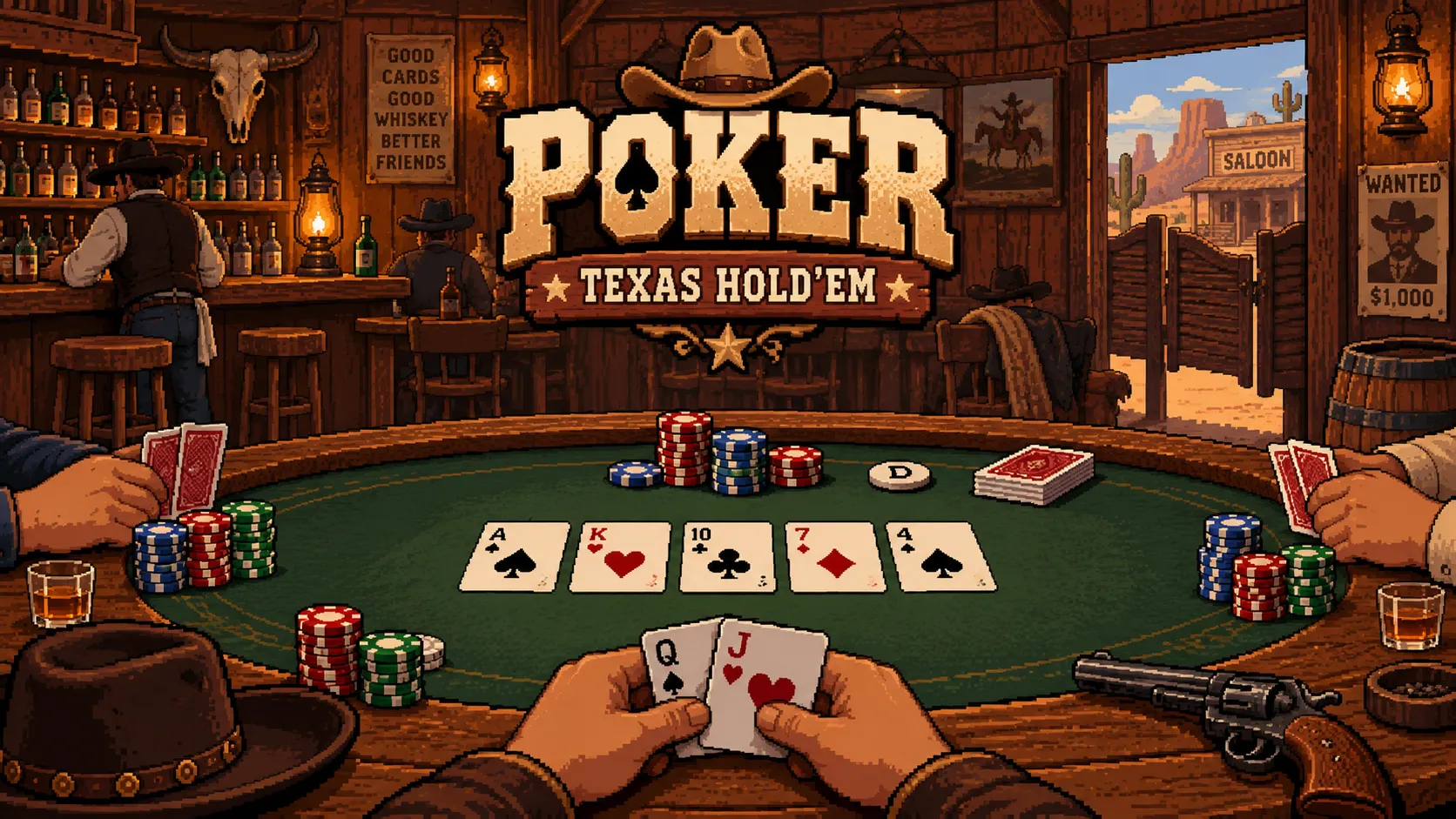
Texas Hold'Em is the poker variant most people mean when they say poker. You get two private cards, five more are dealt face up in the middle for everyone to share, and the best five-card hand you can make from those seven wins. What makes it a game rather than a lottery is that there are four rounds of betting along the way, and you can win without ever showing your cards.
Opka's table is play money. There is no deposit, no cashier, no account balance, and no way to wager anything real. The chips are a number in your browser that resets when you want them to, and the only thing at stake is whether you beat the bots.
The table is no-limit: any bet can be your whole stack. You sit against two to five computer opponents who play their own cards honestly and not very well — they never see yours, and they do not bluff. Beating them is not proof of much, but it is a fair way to learn the shape of the game.
How a hand is played
Two players post forced bets called blinds so there is something to play for. Everyone then receives two private cards, called hole cards, and the first round of betting happens.
Three community cards are then dealt face up — the flop — and there is another round of betting. A fourth card, the turn, brings a third round, and a fifth, the river, brings the last. If two or more players are still in after that, they show their cards and the best hand takes the pot.
- Pre-flop: two hole cards each, first betting round.
- Flop: three shared cards, second round.
- Turn: a fourth shared card, third round.
- River: a fifth shared card, final round.
- Showdown: best five cards from your seven.
Making a hand from seven cards
Your hand is the best five cards you can assemble from your two hole cards and the five on the board. You may use both hole cards, one, or neither — if the board itself is the best five cards available to you, that is your hand, and it is also everyone else's.
That last case is worth understanding early. A board showing a straight belongs to everybody still in the pot, so a hand that looks strong can be worth exactly nothing extra. The question is never how good your cards are, it is how much better they are than what the board already gives your opponents.
Hand rankings, strongest first
Every hand falls into one of nine categories. Within a category, the higher cards win, and when those match too, the unused cards — the kickers — settle it. Two hands that match all the way down genuinely tie and split the pot.
- Straight flush: five in a row, all one suit. Ten to Ace is a royal flush.
- Four of a kind: all four of one rank.
- Full house: three of one rank and two of another.
- Flush: any five of one suit.
- Straight: five in a row, any suits.
- Three of a kind: three of one rank.
- Two pair: two of one rank and two of another.
- Pair: two of one rank.
- High card: none of the above.
The one straight that surprises people
An Ace is normally the highest card, but it also plays as a one at the bottom of a straight: A-2-3-4-5 is a legal straight, usually called the wheel. It is the weakest straight there is, so it loses to 6-5-4-3-2.
The Ace does not bridge both ends at once, though. Q-K-A-2-3 is not a straight and never has been — the run has to be five consecutive ranks, and a straight cannot wrap around the top.
Betting, and what no-limit means
On your turn you can fold and give up the hand, check if nobody has bet, call to match the current bet, or raise. No-limit means a raise can be anything from the minimum up to every chip in front of you.
The minimum raise is the size of the last one. If someone bets 100 and you want to raise, you must make it at least 200 — the 100 you are calling plus 100 more. A player without enough chips for a full raise can still move all in for whatever they have, which is a call for less rather than a raise.
Folding costs you nothing you have not already put in, and chips you have already bet are not yours any more. The most expensive habit in poker is calling one more bet because of what is already in the pot.
Side pots, and why an all-in cannot win everything
A player can only win what they could have lost. If you are all in for 200 and two opponents keep betting to 1,000, you are competing for 200 from each of them and no more. Your 600 is the main pot; the other 1,600 becomes a side pot that only the two players who could cover it can win.
This is why a short stack can win a showdown with the best hand and still see most of the money go elsewhere. It is also why side pots are settled separately: the main pot goes to the best hand among everyone, and each side pot goes to the best hand among the players who paid into it.
Where to start if you are new
Play far fewer hands than feels natural. Most starting hands are losers, and the single biggest leak for a new player is calling with hands that are not good enough to raise with.
Position matters more than most beginners expect. Acting last in a betting round means you have seen what everyone else did before you decide, and that information is worth more than a small edge in cards.
Treat the board as everyone's. Before deciding your hand is strong, look at what the five shared cards would give an opponent who stayed in — three to a flush, or four to a straight, changes the value of your pair considerably.
- Fold most starting hands; raise the ones you play.
- Prefer hands you can play from late position.
- Read the board for what it gives your opponents, not you.
- Chips already in the pot are not a reason to add more.
This is a play-money table
There is no real-money wagering on Opka and no route to any. The chip stack is local to your browser, it is not tied to an account, nothing is bought and nothing is paid out. Hold'Em is here as a game of decisions and incomplete information, which is the interesting part of it.
If gambling is something you would rather not be around, this is a reasonable page to skip — the table is a faithful model of the real game even though the chips are not. Free help is available in most countries; in the UK, GamCare runs a confidential helpline on 0808 8020 133.
Hold'Em, Blackjack, and Gin Rummy
Blackjack and Hold'Em look related because both involve chips, but they are opposite kinds of problem. Blackjack has one correct play in every situation and a dealer who follows a script; the whole game is knowing the table and executing it. Hold'Em has no correct play you can look up, because the right answer depends on what your opponents would do, and they are deciding the same thing about you.
Gin Rummy is closer to Hold'Em in one respect: you are reading an opponent from limited information, and what they discard tells you something. But Gin has no betting, so there is nothing to risk and nothing to represent. Hold'Em's betting is what lets a worse hand win, and that is the part neither of the other two has.
Of the three, Hold'Em is the only one where you can play perfectly and still lose, and play badly and still win. Over one hand that makes it frustrating; over many, it is the whole appeal.