


Guide
How to Play Spider Solitaire
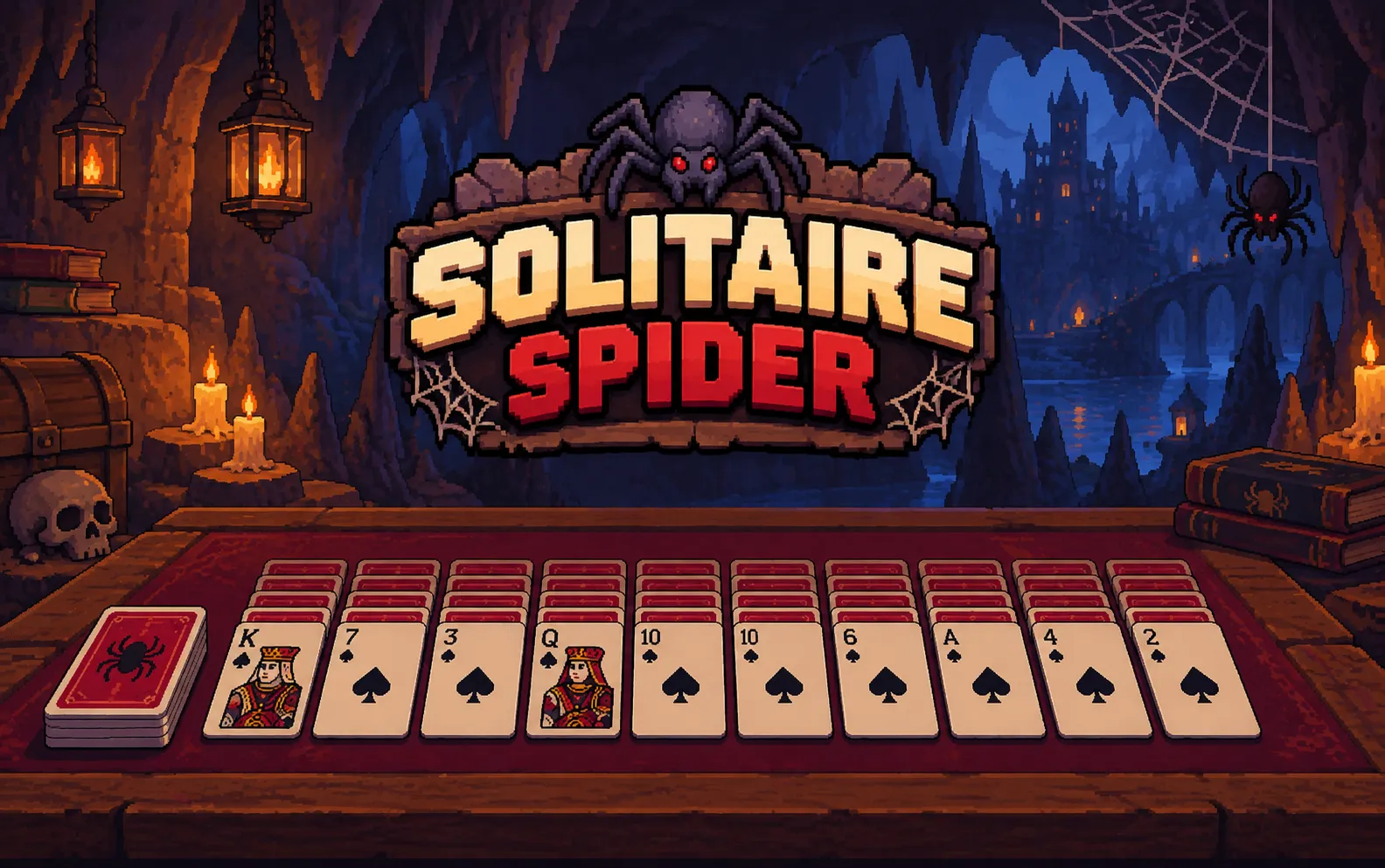
Spider Solitaire is the long-form tableau builder in the Solitaire family. Instead of building four Ace-up foundations, you assemble complete descending same-suit runs from King down to Ace. When a full run is complete, it leaves the board.
The Opka table starts with approachable 1-suit Spider and lets you switch to 2-suit or 4-suit from the game chrome. The rules stay the same; the number of suits changes how often natural runs appear and how carefully you must protect empty columns.
How Spider Solitaire is set up
Spider uses 104 cards, the equivalent of two full decks. The cards are dealt into ten tableau columns: the first four columns receive six cards each, the other six columns receive five cards each, and only the top card of every column starts face up.
The remaining 50 cards become the stock. A stock deal places one face-up card onto every tableau column, so the stock is used in five rows of ten cards.
- Tableau: ten columns where every build and run happens.
- Stock: 50 cards dealt ten at a time.
- Completed runs: eight King-to-Ace same-suit sequences must be removed.
- Difficulty: 1 suit, 2 suits, and 4 suits use the same rules with different suit mixes.
Legal moves
Tableau cards stack downward by rank regardless of suit. For example, a 7 can sit on any 8. That makes it easy to create mixed piles, but mixed piles are limited: you may only lift and move a sequence when every card in that moving sequence is descending and the same suit.
Any movable card or valid same-suit sequence can move into an empty column. Unlike Klondike, empty Spider columns are not King-only, which makes them powerful planning spaces.
Stock deals and empty columns
A stock deal is only legal when every tableau column has at least one card. This rule matters because empty columns are so valuable. You can use them to rearrange a same-suit sequence, but you must fill every empty column before taking the next row from the stock.
After a move exposes a face-down card, that card flips automatically. If a complete same-suit King-to-Ace run appears at the top of a column, Opka removes it automatically as part of the move log.
1 suit, 2 suits and 4 suits
1-suit Spider is the best learning table because every card belongs to the same suit. Most descending builds are also movable sequences, so the game emphasizes column management and stock timing.
2-suit Spider introduces mixed piles without becoming as punishing as the full game. 4-suit Spider is the classic expert version: stacking is still allowed across suits, but movable same-suit chains are harder to build and protect.