
Guide
How to Play Spades
Spades is a partnership trick-taking game built on a promise. Before a single card is played, you look at thirteen cards and say how many tricks you will win. Your partner does the same, the two numbers add together, and that total is a contract the two of you have to meet. Make it and you score. Miss it and the same number is taken off you instead.
That one mechanic is what separates Spades from most card games. You are not trying to win as many tricks as possible — you are trying to win exactly as many as you claimed. Winning too many is its own slow punishment: every trick past your contract becomes a bag, and ten bags cost you a hundred points. A hand where you take nine tricks on a bid of four can be worse than a hand where you take four.
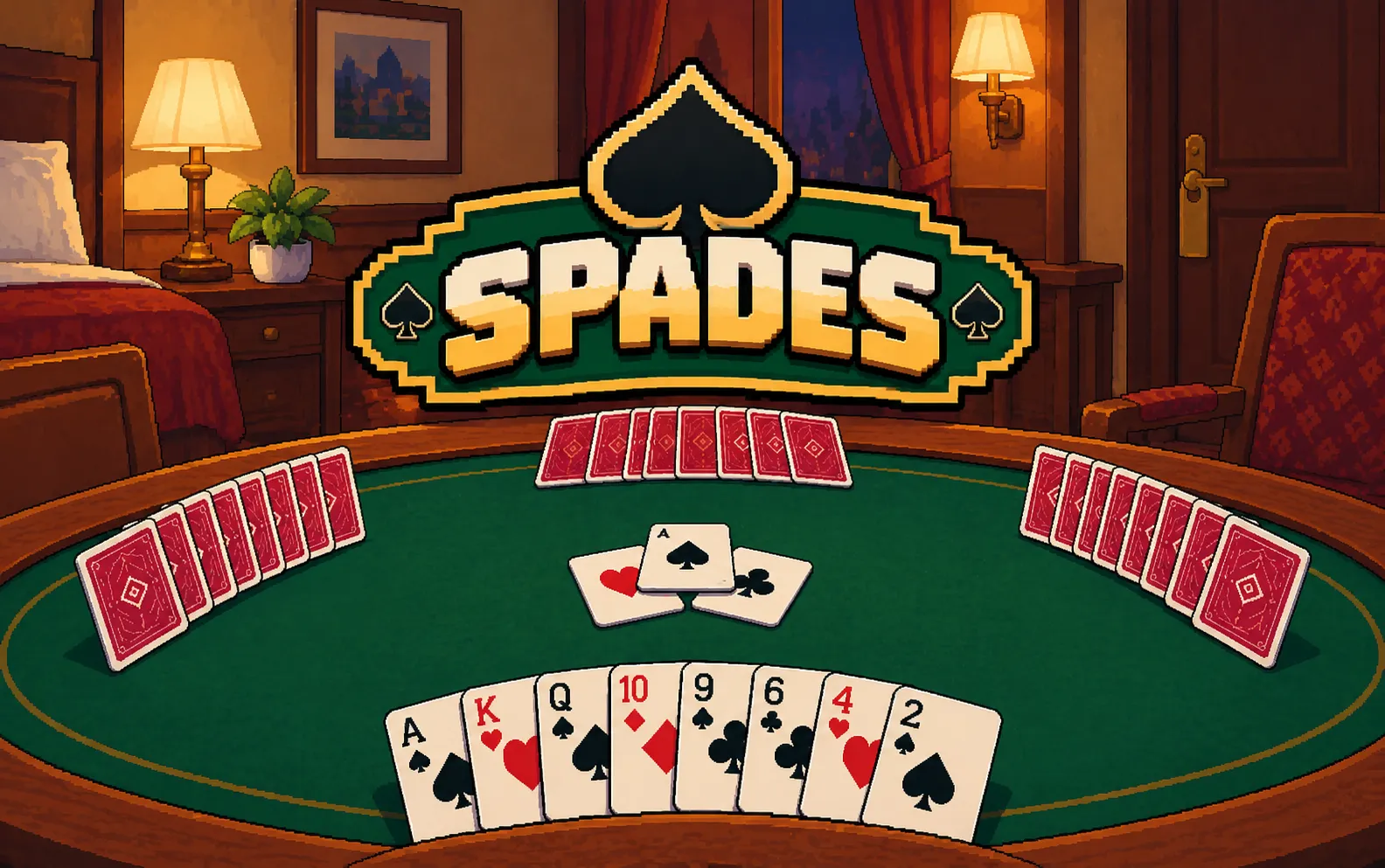
On Opka you sit at seat South with an AI partner across the table at North, against an AI partnership East and West. The engine owns every rule — what you may legally play, when spades become available, how bags and nil resolve — and the table plays to 500.
How a hand of Spades is set up
Four players sit in fixed partnerships, each partner directly across from the other, so the turn order alternates between the two teams. A full 52-card deck is dealt out completely: thirteen cards each, no kitty and nothing left over. Because every card is in play, the thirteen tricks in a hand are always all accounted for.
Bidding goes clockwise starting to the dealer's left, and that same seat leads the first trick. The deal rotates one seat after every hand, so the advantage of bidding last moves around the table.
- Two fixed partnerships, partners sitting opposite each other.
- Thirteen cards each, the whole deck, thirteen tricks a hand.
- Bidding and the opening lead both start left of the dealer.
Bidding
Each player names a number from 0 to 13. Your partnership's contract is the sum of the two bids, and the two of you meet it together — there is no requirement that each partner take their own number individually. If you bid 3 and your partner bids 5, any split of eight tricks between you makes the contract.
You bid on what your hand can actually win, which mostly means high spades, side-suit aces and kings, and length. A sixth spade is worth a trick even if it is a four, because by the time the suit has run everywhere else it will be the only card left that can win. Short side suits are worth something too: being out of hearts early means your spare spades can start taking hearts tricks.
- Bids are 0 to 13; the two partners' bids add into one contract.
- Either partner can take the tricks — the total is what counts.
- Count high trump, side aces, trump length, and short suits.
Trump and the rule about leading spades
Spades are permanently trump. A spade beats any card in any other suit, so a two of spades takes a trick led with the ace of hearts. Within a suit the ace is high and the two is low.
You must follow the suit that was led if you hold it. Only when you are void in that suit may you play something else, and that is when you can choose to trump the trick or throw away a card you do not want.
The one restriction is on leading. Nobody may lead a spade until spades have been broken, which happens the first time a spade is played at all — usually when somebody who was void in the led suit trumps in. The exception is the hand that has nothing else: if every card you hold is a spade, you may lead one.
- Spades beat every other suit; ace high, two low within a suit.
- Follow the led suit whenever you hold it.
- No leading spades until the first spade has been played by anyone.
Bags: the cost of winning too much
Every trick your partnership takes beyond its contract is a bag, and each bag is worth one point at the time. That looks like a bonus, and for a while it is. But bags accumulate across hands, and the moment your team's total reaches ten, a hundred points come off your score and ten bags are cleared from the count.
So a partnership that habitually over-delivers is quietly building a hundred-point bill. This is why experienced players deliberately throw tricks away once the contract is safe: ducking with a low card instead of winning with a high one keeps the bag count down. A set contract earns no bags at all — if you were going to miss anyway, the extra tricks you did take are simply lost.
- Each overtrick is one point now and one bag on the running count.
- Ten bags costs 100 points, and ten are cleared from the count.
- Once the contract is safe, ducking beats winning.
Nil
A bid of 0 is nil: a claim that you will not win a single trick all hand. It pays 100 if you get through clean and costs 100 if you take even one, which makes it the biggest single swing available without a blind bid.
Nil is scored on its own, separate from the partnership contract. Your partner still bids their own number and that number alone becomes the contract, so they are playing for two. The subtlety is what happens when a nil breaks: the tricks you accidentally won still count toward your partner's contract, so a broken nil sometimes hands your own team the contract while costing you 100.
Hands that suit nil are short in spades, low in spades, and hold no unguarded aces or kings — anything that can be forced to win is a liability. Playing one is about shedding your highest safe card at every opportunity, so that you still have something low left when a suit comes around again. Your partner's job is the opposite: take tricks aggressively, including tricks you might otherwise have won, to keep them off you.
- Nil is a bid of 0: +100 for zero tricks, −100 for any.
- Scored separately; your partner's bid is the whole contract.
- Tricks a broken nil took still count for the partnership.
How scoring works
Meet your contract and you score ten points per trick bid, plus one for each bag. A partnership that bid five and took six scores 51. Miss it and you lose ten per trick bid: the same bid of five taking only four is −50, and none of the four tricks earns anything.
Nil bonuses and penalties are added on top, and the bag penalty is subtracted whenever the count crosses ten. All of it lands on one running partnership score.
The match runs to 500. Because a single hand can carry both teams past the target, the higher score takes the win, and an exact tie plays another hand.
Spades and Hearts
Both deal the whole deck to four players and both are played in tricks, which is where the resemblance ends. They are almost mirror images of each other.
Hearts has no trump suit and no partnerships. Everyone plays for themselves, and the goal is inverted: you are trying not to win, because each heart you collect costs a point and the queen of spades costs thirteen. Low score wins, and the sting is that taking every penalty card at once — shooting the moon — flips the scoring entirely.
Spades has a permanent trump suit, fixed partners, and a target you announce in advance. Nothing is a penalty card; a trick is simply a trick. The tension is not avoidance but accuracy, and it is shared with a partner whose bid you cannot see the hand behind.
If you like Hearts for the card-counting and the dread of being handed the queen, Spades will feel more like a negotiation: you commit to a number and then find out whether your partner's number and yours can be met together.