Guide
How to Play Crosswords
A crossword is two puzzles sharing one grid. Every white square belongs to an across word and a down word at the same time, so a letter you are confident about is not just an answer — it is a clue to the answer crossing it. That is the whole engine of the game. You almost never solve a crossword clue by clue in order; you solve the ones you know, and the letters they leave behind turn the ones you do not know into something guessable.
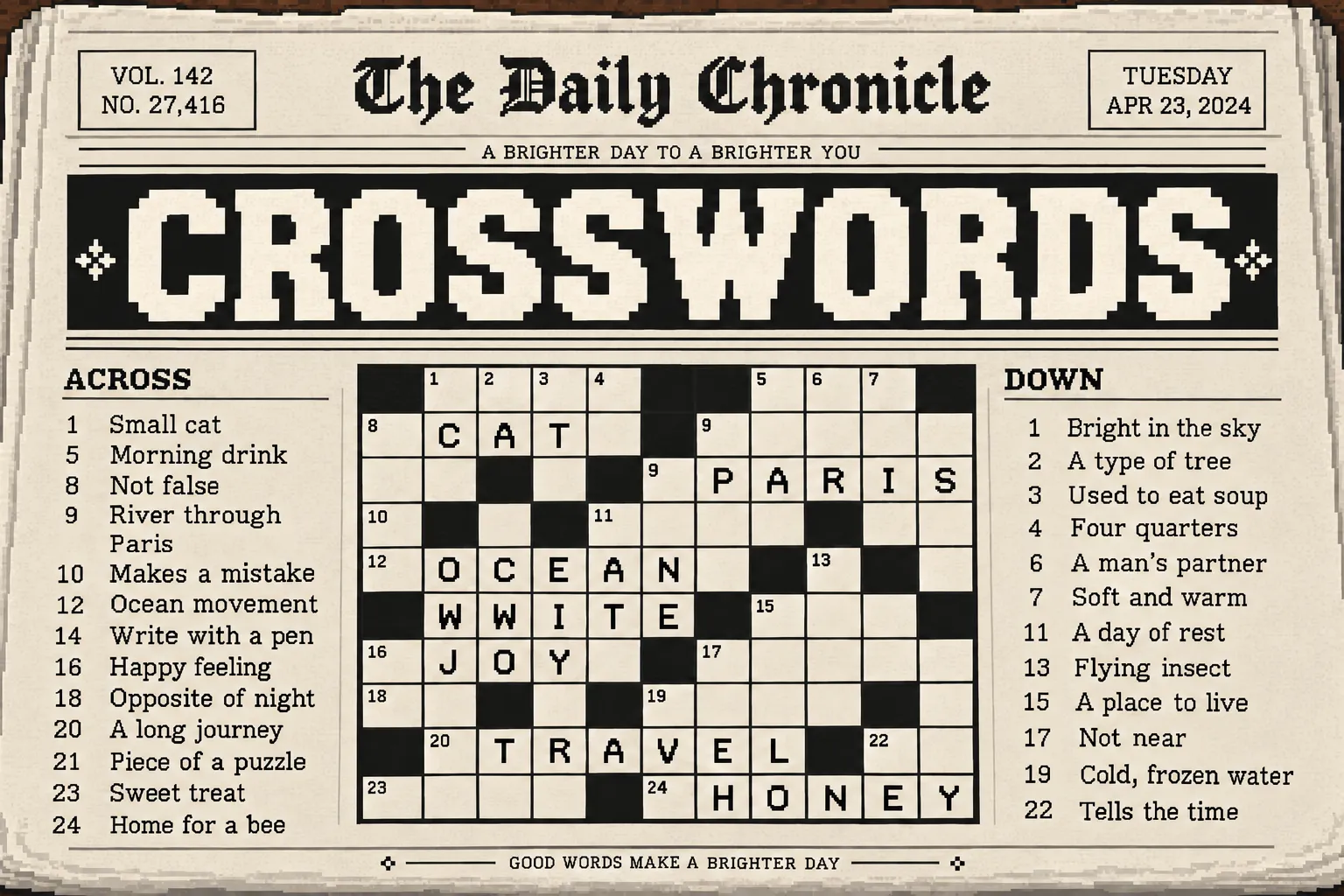
Opka's crosswords are American-style. The grid is fully checked, meaning there is no square that only one word passes through, and every entry is numbered from the square it starts in, counting left to right and top to bottom. The clue lists follow those numbers: 1-Across and 1-Down both begin in the same square and head in different directions.
There are three grids to choose from, and they get harder in two ways at once. The five by five warm-up has no black squares at all and clues that are close to dictionary definitions. The eleven by eleven expects you to read a clue twice. Nothing in between is padding — every grid here was built to be finished in one sitting.
How to play
Click a square, or use the arrow keys to move to it, and type. The highlighted word tells you which clue you are answering; clicking the same square again turns the highlight ninety degrees so you can answer the other one. Typing fills the current word one square at a time and skips over letters that crossing answers have already supplied.
You do not have to finish a word before moving on, and nothing is committed. A crossword is meant to be written in pencil: put in your best guess, let a crossing prove it wrong, and type over it.
- Arrow keys move, letters fill, Backspace clears.
- Tab and Shift+Tab move to the next and previous clue.
- Clicking the square you are already on switches between across and down.
- Clicking a clue jumps to the first empty square in that answer.
How checking works
Check marks the squares you filled in that hold the wrong letter. It never marks a square you left empty, because an empty square is not a mistake yet, and it never tells you what the right letter would have been. There are three sizes of it: check the square you are on, check the whole answer you are working on, or check the entire grid.
A mark is not permanent. It stays while you look at it and disappears the moment you type something different into that square, so a checked grid does not slowly fill up with red from mistakes you already fixed. Checking again re-reads the squares in that scope and clears the marks on any that have since been corrected.
- Check square: just the one you are on.
- Check word: every letter of the answer you are in.
- Check puzzle: every letter you have written anywhere in the grid.
- Marks clear themselves when you retype the square.
Revealing a letter
Reveal fills the square you are on with the correct letter and locks it. It is the one move in the game you cannot take back by typing over it, which is deliberate: a revealed letter is the puzzle answering for you, and it should feel different from a letter you worked out.
Reveal is per-square on purpose. There is no reveal-word and no reveal-puzzle button, because a crossword that can be finished with one click stops being a crossword. One stubborn letter unlocking a corner you can then solve yourself is the useful version of help.
When a puzzle is finished
The grid is complete when every white square holds its own correct letter — not when every square has something in it. Filling the last square with a wrong guess does not end the puzzle, and the board simply stays in play until the mistake is corrected.
Because completion is judged letter by letter against the solution, there is no partial credit and no ambiguity about whether you finished. The summary at the end reports how many checks and reveals you used along the way, so a clean solve and a heavily assisted one are told apart honestly.
Where these puzzles come from
Every grid and every clue on this page was written for Opka. Nothing here is transcribed, adapted, or scraped from a newspaper, a puzzle app, or an archive: the fills were built against a plain English word list and the clues were written to them afterwards.
That matters beyond the legal question. A borrowed puzzle carries the assumptions of wherever it came from — the abbreviations that publication favours, the names its readers are expected to know. Writing our own means the clue difficulty can be tuned to a general audience playing in a browser, which is the only audience this page has.