Guide
How to Play Sudoku
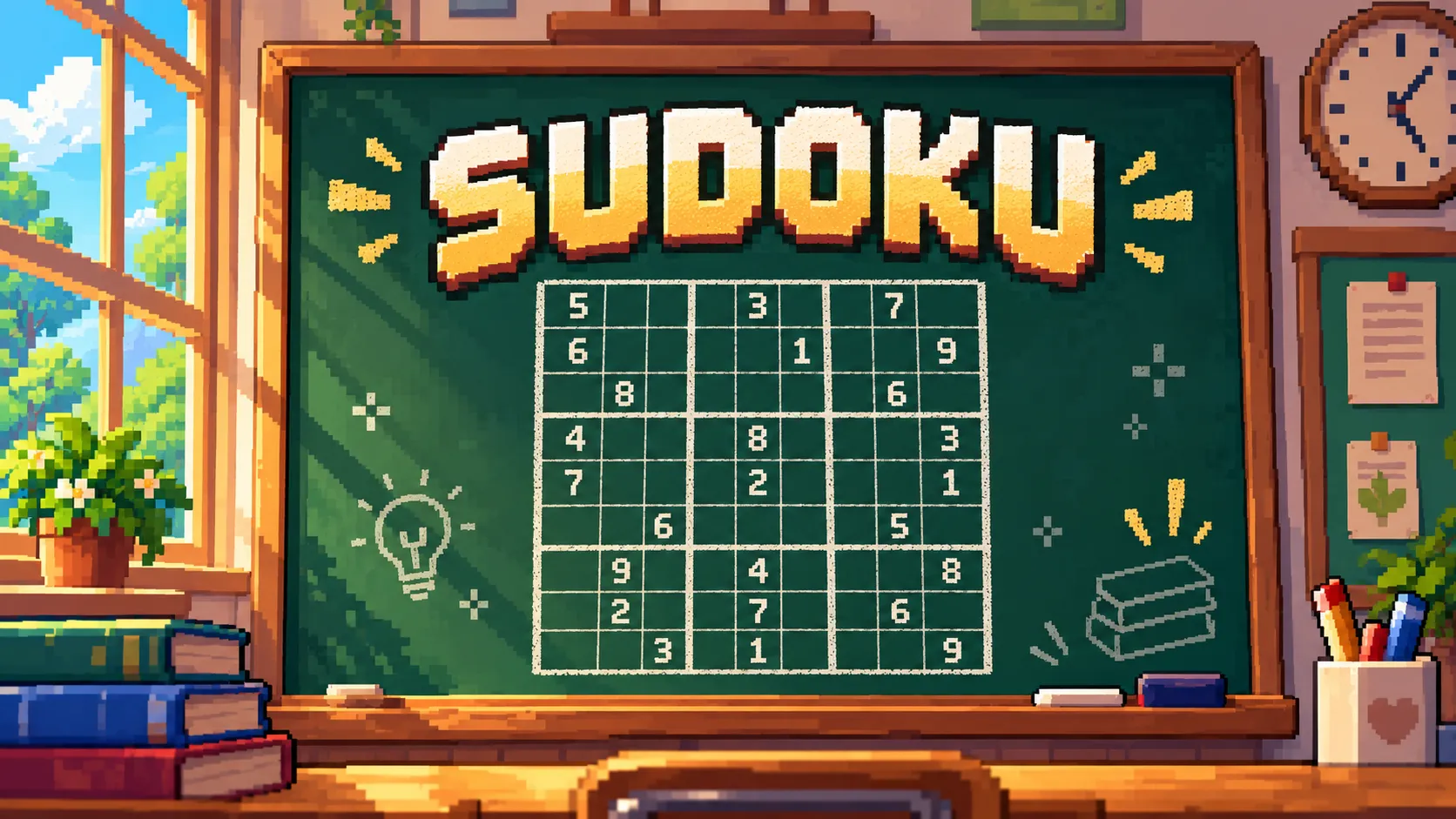
Sudoku is a pure deduction puzzle. You are given a 9 by 9 grid with some digits already filled in, and the whole game is one rule: every row, every column, and every 3 by 3 box must end up holding each digit from 1 to 9 exactly once. Nothing is hidden and nothing is random once the board is dealt — every remaining digit is already determined by the clues in front of you.
That is what separates Sudoku from most puzzle games: you are never guessing, you are finding the cell whose answer has already been forced. A good solve is a chain of small certainties, each one narrowing the next. The difficulty of a puzzle is really the length of that chain — how many steps you have to see ahead before a digit becomes unavoidable.
Opka generates every board in your browser from a seed, then verifies it has exactly one solution before you ever see it. Pencil marks, a conflict highlight, unlimited undo, and a one-digit hint are all there when you want them, and none of them are required to finish.
How a Sudoku grid is set up
The board is 81 cells: nine rows of nine, divided by heavier lines into nine 3 by 3 boxes. Some cells arrive already filled — those are the clues, or givens, and they never change. Every other cell is yours to fill with a digit from 1 to 9.
How many clues you start with is what Opka's difficulty setting controls. Easy boards keep around 42 clues, medium around 34, and hard around 27. Fewer clues means longer chains of reasoning before the next digit is forced, not a different rule set.
- 81 cells arranged as nine rows, nine columns, and nine 3 by 3 boxes.
- Clues are fixed and cannot be edited, cleared, or overwritten.
- Every empty cell has exactly one correct digit.
Rows, columns, and boxes
Each cell belongs to three groups at once: its row, its column, and its 3 by 3 box. A digit may appear only once in each of them, so any digit already placed in one of a cell's three groups is ruled out for that cell. Those three overlapping groups are the entire engine of the puzzle.
That overlap is where deductions come from. If a box is missing a 7 and two of its three empty cells sit in rows that already contain a 7, the 7 belongs in the third cell — not because you tried it, but because nowhere else is left. The same argument runs the other way: if a row is missing a 4 and only one of its empty cells has no 4 in its column or box, the 4 is settled.
- Twenty other cells share a group with any given cell.
- A digit already in a cell's row, column, or box cannot go in that cell.
- Look for the group where a digit has only one place left to go.
Legal moves
You can fill an empty cell with any digit and clear it again, in any order, as many times as you like. Clues are the only cells that refuse input.
Placing a digit that already appears in the same row, column, or box is allowed. Opka does not block it — it highlights every cell in the clash so you can see the mistake and decide what to do about it. Blocking the move outright would quietly solve the puzzle for you, because being unable to place a digit is itself a deduction.
Undo steps back through everything, including hints and pencil marks, so exploring a line and reversing it costs nothing.
Notes and pencil marks
Turn on notes and a digit you press is written into the cell as a small pencil mark instead of an answer. A cell can hold any combination of marks, and pressing a marked digit again removes it.
Notes are how you hold a deduction you are not ready to commit to. The standard technique is to mark every digit a cell could still take, then watch the marks thin out as you fill in neighbours. When a cell is down to one mark, that mark is the answer. When a digit appears as a mark in only one cell of a row, column, or box, it belongs there.
Marks are yours to manage: filling a cell clears its own marks, but Opka never rewrites marks in other cells on your behalf. Clear a cell's notes in one press when a line of reasoning turns out to be wrong.
- Notes toggle: press a digit to add a mark, press it again to remove it.
- A cell with one remaining mark is a solved cell.
- A digit marked in only one cell of a group belongs in that cell.
Why every Opka puzzle has one solution
A Sudoku with two possible completions is a broken Sudoku: somewhere in it you would have to guess, and both guesses would be defensible. Opka's generator rules that out. It fills a complete grid from your seed, then removes clues one at a time, and keeps a removal only if the remaining board still solves exactly one way. The moment a removal would allow a second solution, the clue goes back.
So a hard board is hard because the reasoning is long, never because information is missing. If you are stuck, there is a next step you have not spotted yet — and the hint button will reveal exactly one correct digit rather than a whole region, so the rest of the deduction stays yours.
Win condition
The puzzle is solved when all 81 cells are filled and no digit repeats in any row, column, or box. There is no losing state and no timer forcing an end: a wrong digit is just a cell to revisit.
Because each board has a single solution, a complete and conflict-free grid is the solution. Check will point out any filled cell that disagrees with it if you would rather not hunt for the mistake yourself.
Sudoku and Minesweeper
Both are grid puzzles solved by reading numbers, so they get compared often, but they ask for different things. Minesweeper hides its board: the numbers describe adjacent mines you cannot see, and a genuinely ambiguous position can force a coin-flip that ends the game. Sudoku shows you everything from the first move, and a correct puzzle never forces a guess.
The failure modes differ too. In Minesweeper one wrong click is fatal and unrecoverable. In Sudoku a wrong digit costs you only the moves it takes to notice and undo it, which is why Sudoku rewards patient verification while Minesweeper rewards probability and speed.
There is also no arithmetic in Sudoku despite the digits. The nine symbols could be nine colors or nine shapes without changing a single deduction — they are labels, not quantities.