Guide
How to Play Word Search
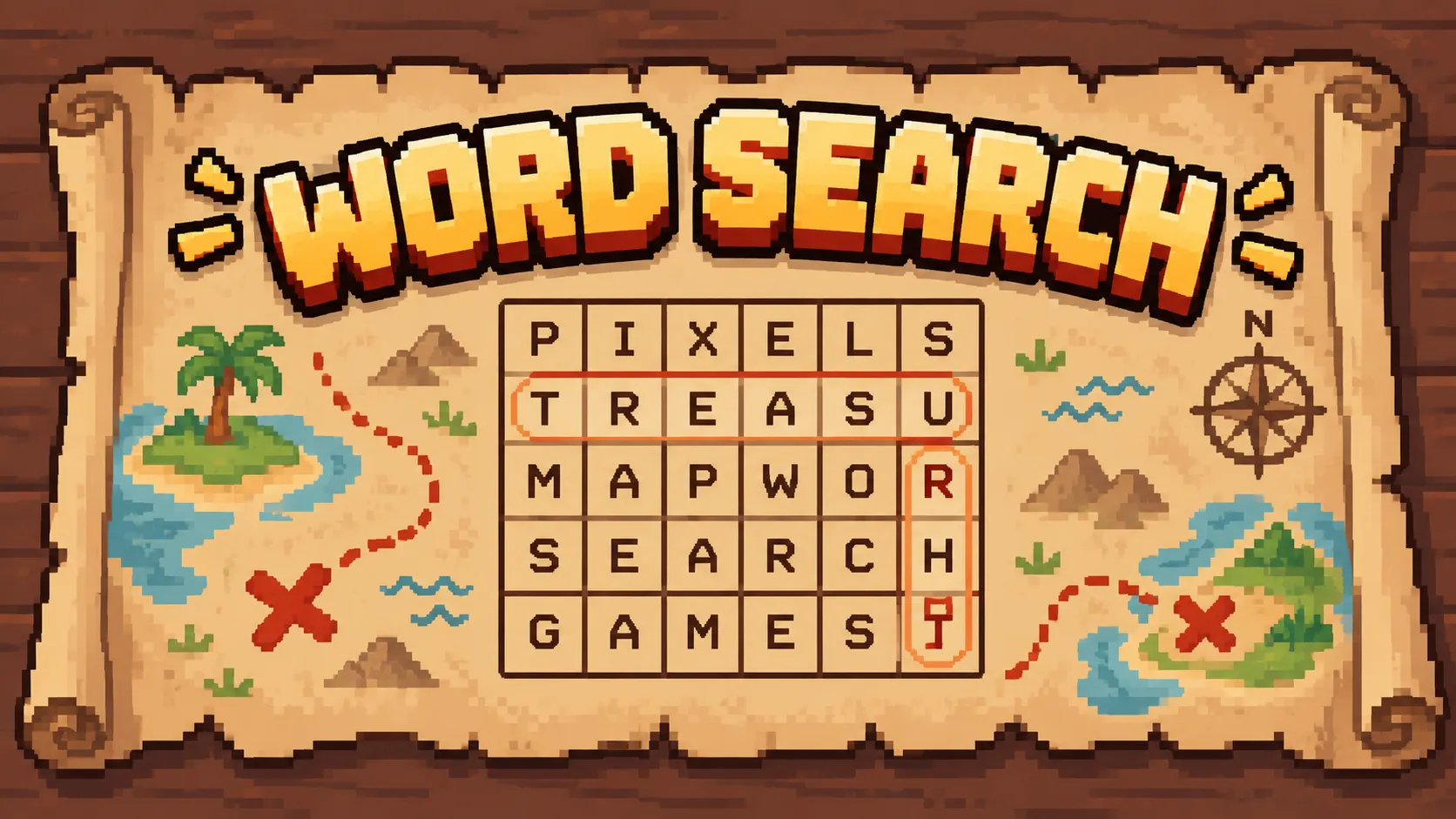
A word search is a grid of letters with a list of words hidden inside it. Every word on the list is genuinely in the grid, running in a straight line, and your job is to spot each one and mark it. There is no penalty for looking in the wrong place and no clock you have to beat, which makes it the most forgiving game on Opka and a good one to play while thinking about something else.
What makes a grid hard is not the words, it is the directions. On Opka a word can run any of eight ways: left to right, right to left, top to bottom, bottom to top, and along all four diagonals. A word spelled backwards down a diagonal is the same word and counts the same, which is why scanning only left-to-right will always leave some of the list unfound.
You can pick a category or take a random list, and choose an 8 by 8, 12 by 12, or 16 by 16 grid. Bigger grids hold more words and more places to hide them. Every puzzle is generated from a seed, so a grid is a real puzzle rather than a fixed one, and you will not see the same board twice unless you ask for it.
How a Word Search is set up
The board is a square grid of letters with a word list beside it. Every letter that is not part of a hidden word is filler, chosen at random, which is what makes the words hard to see rather than obvious.
Words are allowed to cross each other, sharing a letter where they intersect. That is a feature of a well-packed grid rather than a mistake: a single letter can belong to two different answers.
- Grid: 8 by 8, 12 by 12, or 16 by 16, your choice.
- Word list: six, ten, or fourteen words, scaled to the grid.
- Filler: every other cell, random letters.
- Crossings: two words may share a letter.
The eight directions
Opka uses all eight directions. A word can read east, west, north, south, or along any of the four diagonals, which means it can be written backwards or upside down relative to how you would normally read it.
Some word searches use only four directions, or forbid reversals, to make the puzzle easier. This one does not — if you have found every word you can read left to right and the list is not empty, the rest are running some other way, and the diagonals are usually where they are.
- East and west: along a row, forwards or backwards.
- North and south: down a column or up it.
- All four diagonals, in both directions.
Finding and marking a word
Drag from the first letter of a word to its last, or tap the first letter and then the last. The board draws the line between them, and if it matches a word on the list, the word is struck through and the letters stay highlighted.
Direction does not matter when you mark a word. Dragging from the last letter back to the first is the same find, because you spotted the same word in the same place. A selection that is not a straight line in one of the eight directions is not a guess at all — the board simply does not take it.
A wrong selection costs nothing. There is no limit on attempts and no score to protect, so there is no reason not to check a hunch.
Choosing a grid size
The 8 by 8 grid holds six words and is a two or three minute puzzle. The 12 by 12 holds ten and is the default, which is about as much as fits comfortably on a phone screen. The 16 by 16 holds fourteen and has enough room that words cross each other often, which is what makes the larger grid feel different rather than just longer.
Size also changes which words can appear, since a word cannot be longer than the side of the grid it has to fit along. The 8 by 8 therefore draws from shorter words, and the 16 by 16 can use the longest in the list.
How to actually find them faster
Most people scan the grid looking for a whole word, which is slow because you are trying to match eight directions at once. Scanning for a single distinctive letter is much faster: take the rarest letter in the word you want — a J, Q, X, Z, or a K or W — find every copy of it in the grid, and check the eight directions around each one.
For words with no rare letter, double letters work the same way. A word like BALLOON or ESPRESSO gives you a pair to look for, and pairs are easy to spot in a field of random letters because the eye catches repetition.
The other habit worth building is scanning by direction rather than by word. Read one full diagonal at a time looking for anything on the list, instead of picking a word and hunting for it. A word you were not looking for turns up on the way.
Where these words come from
The word list is the same one Hangman uses, and every entry on it was chosen by hand for Opka. It is not ENABLE, TWL, SOWPODS, or any other dictionary file, so there is no third-party word list behind the game and nothing here carries a redistribution condition.
Word Search narrows that list rather than replacing it. A grid has no cell for a space, so multi-word answers like New Zealand are excluded here even though Hangman uses them, and a word can never be longer than the side of the grid. What is left is the same curated set of categories: letters only, nothing obscure, and no proper nouns outside Countries.
Word Search, Hangman, and Crosswords
The three word games on Opka test three different things. A crossword gives you a definition and asks you to produce the word from nothing. Hangman gives you a length and asks you to deduce the word by spending six wrong guesses carefully. A word search gives you the words up front and asks only where they are.
That makes Word Search the only one of the three that is a perception game rather than a knowledge or deduction game. You are not being asked whether you know what a pendulum is, or whether you can work it out from P and E — you are being asked to spot eight letters in a row among two hundred and fifty others. Vocabulary barely matters, and that is deliberate.
It is also the one you cannot lose. Hangman ends after six misses and a crossword can defeat you outright, but a word search only ends when you have found everything. The difficulty is in how long it takes, not in whether you get there.