Guide
How to Play Hangman
Hangman is a deduction game wearing a word game's clothes. There is a secret word, you guess one letter at a time, and every letter that is not in the word costs you one of six lives. What you are really doing is narrowing a field: each guess either fills in positions or eliminates a letter, and both of those are information you did not have a moment ago.
The board tells you more at the start than people expect. You know the length of the word, you know where the gaps are, and on Opka you know the category it came from. A nine-letter animal and a nine-letter instrument are very different search problems, and choosing a category is choosing how much help you want.
Opka's version keeps the classic rules: six wrong guesses, one letter at a time, and a repeat costs you nothing because it tells you nothing. Pick a category or take a random word, guess with the keyboard or the on-screen alphabet, and the answer is revealed at the end whether you got there or not.
How Hangman is set up
The game picks a secret word and shows you one blank for each letter in it. Nothing else about the word is revealed: not its first letter, not its category unless you chose one, and not which letters repeat.
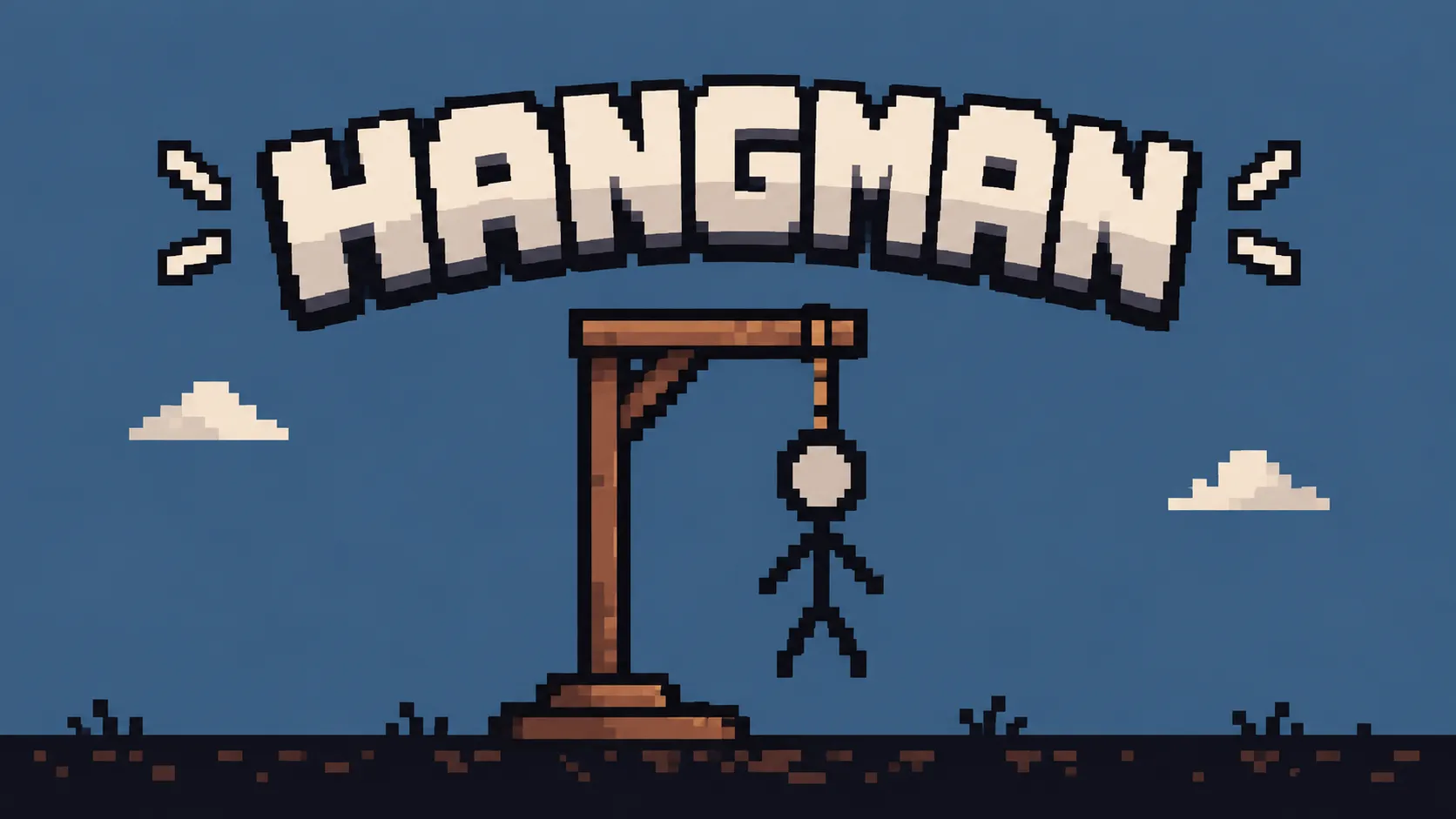
You start with six wrong guesses in hand. Each miss draws one more part of the gallows figure — head, body, two arms, two legs — so the drawing doubles as your life counter. When the sixth part appears, the round is over.
- One blank per letter, so the length is free information.
- Six wrong guesses, drawn as the six parts of the figure.
- Twenty-six letters, each usable once.
- Spaces in multi-word answers are shown from the start.
Legal moves
A move is a single letter. If it appears in the word, every copy of it is revealed at once — guessing E in a word with three Es fills all three for the price of one guess. If it does not appear, you lose a life.
Guessing a letter you have already tried does nothing at all: it does not reveal anything, and it does not cost a life. The alphabet marks every letter you have used, so a repeat is a misclick rather than a decision, and the game treats it that way.
There is no whole-word guess in this version. You win by revealing every letter, which means a word you have already worked out still has to be typed out one letter at a time.
Win and loss condition
You win the moment the last hidden letter is revealed, however many lives you have left. Reaching the final letter with one life in hand counts exactly the same as reaching it without a scratch.
You lose on the sixth miss. Either way the answer is shown at the end, because a Hangman round you lost without ever learning the word is a round you learned nothing from.
Choosing a category
Opka ships eight categories: Animals, Countries, Food & Drink, Science, Sports, Music, Nature, and Around the House. Random draws from all of them at once, which is the harder game, because you lose the single biggest constraint on what the word can be.
A category is worth more than it looks. Knowing that a seven-letter word is an instrument rather than any English word at all cuts the candidate list from thousands to a handful, and it changes which letters are worth spending a guess on. Countries is the one category with multi-word answers, and the spaces are shown from the start.
Letter frequency, and when to ignore it
The standard opening advice is to guess by frequency, and it is good advice for the first two or three guesses. Across English words, E is the most common letter by a clear margin, followed by a group of roughly A, I, R, N, T, O, S and L. Opening with E costs you very little on average and often pays for itself immediately.
Vowels are a special case. Almost every English word contains at least one, so a vowel guess is unusually safe, but there are only five common ones and they tend to reveal fewer positions than a good consonant. The usual compromise is one or two vowels early to get a skeleton, then consonants once the shape is visible.
Frequency stops being the right guide the moment you have a pattern. A word ending in three blanks where the middle one is already N is far more likely to end in -ING than to contain a statistically common letter somewhere else. Once you can see shape, guess the letter the shape demands, not the letter the table recommends.
There are also certainties worth knowing. In this word list every Q is followed by a U, so a revealed Q makes U free. Double letters are common in the middle of longer words, and a revealed letter next to a blank often tells you more than a fresh guess would.
Where these words come from
Every word on this page was chosen by hand for Opka. The list is not ENABLE, TWL, SOWPODS, or any other dictionary file, so there is no third-party word list behind the game and nothing here carries a redistribution condition.
That is a content decision as much as a licensing one. A general dictionary gives you no categories and no way to keep obscure or unpleasant entries out, and both of those matter more in Hangman than in a game where you can see the word. The house rules are simple: letters and spaces only, four to fourteen characters, no proper nouns outside Countries, and nothing about violence or death.
Hangman and Crosswords
Both are word games, but they ask for opposite things. A crossword gives you a definition and asks you to produce the word. Hangman gives you no definition at all and asks you to find the word by elimination — you are not being tested on vocabulary so much as on how efficiently you can spend six wrong answers.
The information also flows differently. In a crossword, a letter you are sure of helps because it crosses another entry, so knowledge spreads sideways through the grid. In Hangman there is only one word, and a guess helps by shrinking the set of words that still fit the pattern. That makes Hangman the more mechanical of the two, and the easier one to get measurably better at.
If you like the deduction and not the vocabulary, Hangman is the one to play. If you like the clue-writing, the crossword is on Opka too, with original grids rather than a word list.