Guide
How to Play Opka Rally
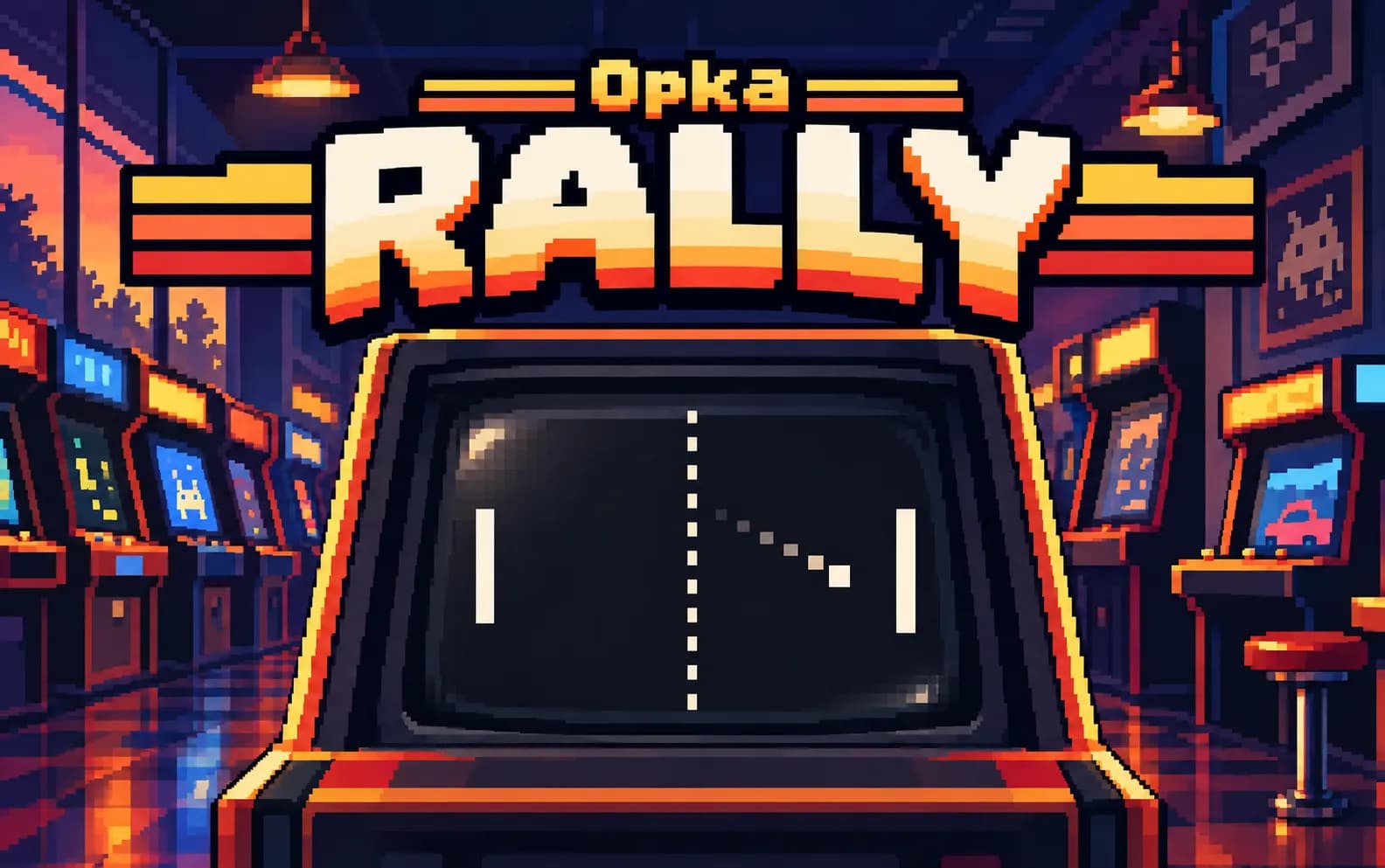
Opka Rally is two paddles and a ball. You move yours up and down, the ball bounces between you, and whoever lets it past their own wall gives the other player a point. First to eleven wins. It is the shortest rulebook of anything on Opka and it still holds up, which is most of why it is worth playing.
What keeps it interesting is the paddle itself. It is not a wall — where along it you make contact decides the angle the ball leaves at, so a good return is aimed rather than merely made. Catching the ball on the end of the paddle sends it away steeply; catching it dead centre sends it straight back.
The ball also speeds up on every hit, so a long rally becomes a different game from the one it started as. Points rarely end because someone was not paying attention; they end because the ball finally got faster than the paddle could answer.
How a point is played
The ball is served from the middle toward whoever last conceded, after a short pause. From then on it travels in a straight line until it hits a paddle or the top or bottom wall, both of which simply reflect it.
If the ball passes your paddle and reaches the wall behind you, your opponent scores and the next serve comes to you. Nothing else ends a point — there is no time limit, no out of bounds along the length of the table, and no way to lose a point except by missing.
- Serve: from the centre, toward whoever conceded.
- Top and bottom walls: reflect the ball.
- Paddle: reflects, and changes the angle.
- Behind a paddle: a point for the other side.
The paddle is an aiming device
This is the whole skill of the game and the thing most people never notice. Where the ball strikes your paddle changes the angle it leaves at: the centre sends it back flat, and the further toward either end you catch it, the steeper it goes.
That means you can choose where to put the ball. Returning it steeply sends it to a corner your opponent has to travel to reach, and against the computer that is the most reliable way to win a point outright. Returning it flat is safe but gives them an easy answer.
It also means a panicked return is usually a bad one. Reaching the ball with the very tip of the paddle produces the steepest angle of all, which is sometimes brilliant and sometimes fires it straight into the wall and back at you faster than before.
Controls
You can play with the keyboard or by dragging. On a keyboard the arrow keys or W and S move your paddle up and down; in two-player mode the second player uses the other set. Space pauses and resumes.
On a touchscreen, or with a mouse, dragging anywhere on the table moves your paddle toward your finger. The paddle still travels at its own speed rather than teleporting, so a fast flick across the table does not beat a ball that was already past you.
- W / S or the up and down arrows: move your paddle.
- Drag anywhere on the table: move toward your finger.
- Space: pause and resume.
- Two-player: one player per key pair, same table.
The ball gets faster
Every time a paddle touches the ball it speeds up slightly, up to a ceiling. A rally that starts comfortably becomes genuinely quick after ten or twelve exchanges, and that acceleration is what resolves points that would otherwise go on forever.
The speed resets when a point ends, so every serve starts from the same pace. A long rally you lose is not a disaster — you do not carry the speed into the next point.
Playing the computer
The computer paddle tracks the ball's current height rather than working out where it will arrive. That is a deliberate limit: an opponent that predicted the landing spot would be unbeatable, because it would simply always be there.
Tracking rather than predicting is also what gives you something to aim at. Because it chases the ball's present position, a steep return leaves it travelling the wrong way at the moment the angle changes, and a well-placed ball to the far corner is the shot it struggles most to reach. It is beatable, and beating it is about placement rather than speed.
Opka Rally, Snake, and the other arcade titles
Snake and Opka Rally are both arcade games with one input and no story, but they fail in opposite directions. Snake gets harder because you get better — every apple lengthens the snake, so success is what eventually kills you, and a run ends permanently. There is no recovering from a mistake.
Opka Rally is the opposite. A mistake costs exactly one point out of eleven, and the game keeps going. You can be losing 0-5 and still win, which means the interesting decisions are about placement and patience rather than survival.
Snake is also a solo run against a scoreboard. Opka Rally has an opponent, even a simple one, so every shot is a choice about where they are rather than only about where you are. That is the difference worth trying both for.