Guide
How to Play Slots
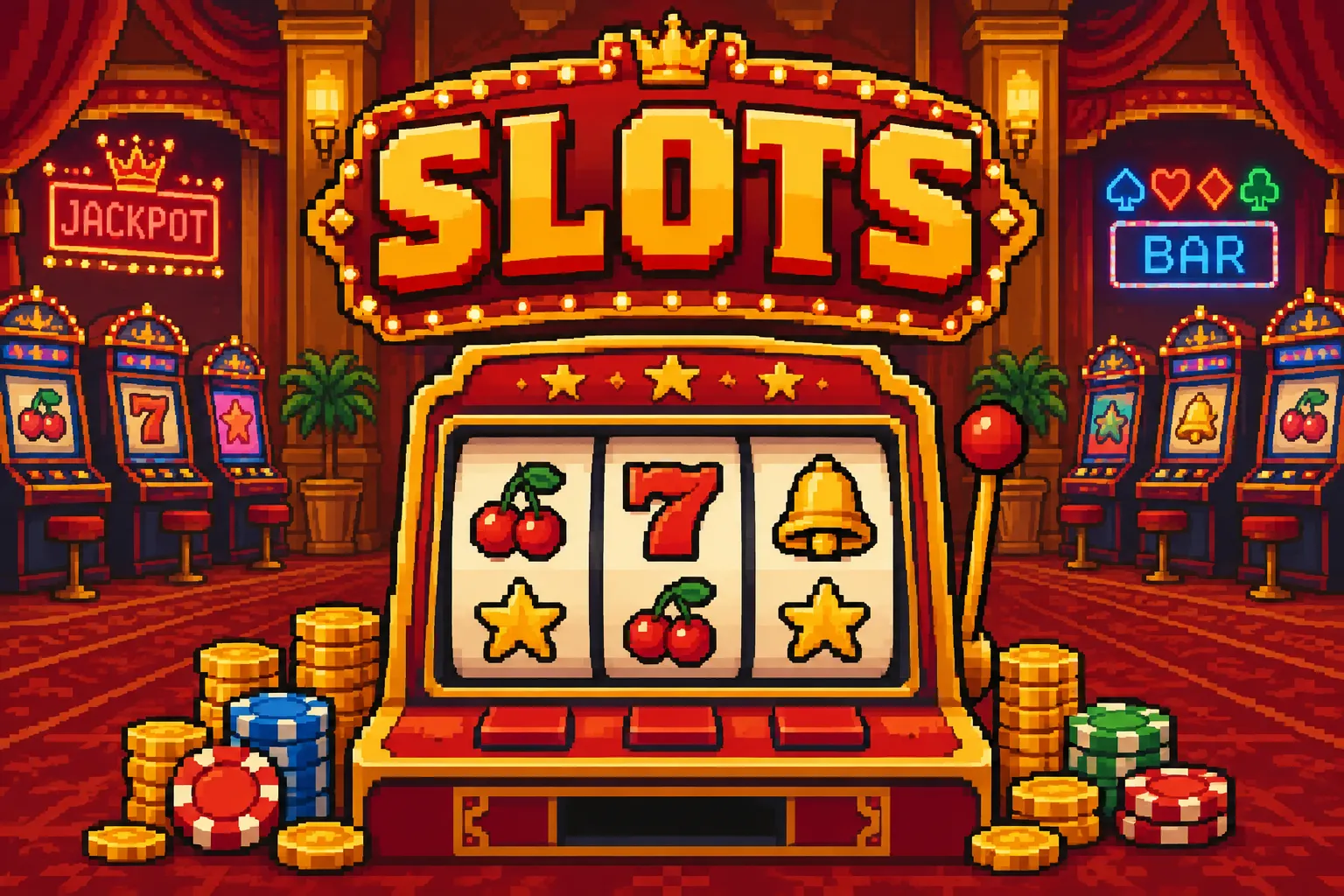
Slots is a three-reel machine with a single payline across the middle. You pick a stake, press spin, and three symbols land in a row. If they make one of the nine combinations on the paytable, you are paid a multiple of your stake. That is the whole game — there is no decision after the spin, and nothing you can do to change where the reels stop.
Because there is no skill in it, the only honest thing to publish is the maths. Every reel on this machine runs the same twenty-symbol strip, and that strip is printed below along with the paytable and the odds of each combination. The machine returns 93.1% of everything staked over its full cycle, which is a number worked out by adding up all eight thousand possible outcomes rather than estimated.
The credits are a score. They cannot be bought, cashed out, or carried anywhere, and there is no wagering of any kind on Opka. When you run out, a refill button puts you back to two hundred and you keep playing. That changes what the game is for: this is a machine to look at and understand rather than one to chase, and the paytable is published so you can see exactly how it is built.
This is a free-play machine, not gambling
No money is involved at any point. You cannot deposit, you cannot buy credits, you cannot withdraw anything, and nothing on this page connects to a payment method or a real-money casino. The credits exist only in your browser for the length of the session.
Running out costs you nothing. There is a refill control that resets you to two hundred credits, and it unlocks the moment your balance can no longer cover the smallest stake. It is there precisely so that going broke is an inconvenience of one click rather than a reason to spend anything.
Real slot machines are designed around the fact that the return is below 100%, which means a player who keeps going is mathematically certain to end up behind. That is true of this machine too — 93.1% — and it is worth seeing clearly on a machine where it costs you nothing to watch it happen. If you or someone you know is struggling with gambling, the national helplines are free, confidential, and available around the clock.
- No deposits, no purchases, no withdrawals, no real-money play.
- Credits are a local score and reset whenever you like.
- The refill button unlocks at zero and costs nothing.
- The published return is under 100% by design, as on a real machine.
The paytable
Exactly one line pays per spin — the best one. Three cherries pay as three cherries rather than also paying the cherry consolations underneath them. Everything is a multiplier of the stake you spun at, so a 30x win on a 5-credit stake returns 150.
The odds below are exact, not estimates. There are twenty positions on each of three reels, so there are 8,000 possible stopping combinations in total, and each row states how many of them it covers.
- Three sevens — 300x — 1 in 8,000
- Three bars — 100x — 1 in 1,000
- Three bells — 50x — 1 in 296
- Three cherries — 30x — 1 in 296
- Three plums — 25x — 1 in 296
- Three oranges — 15x — 1 in 125
- Three lemons — 12x — 1 in 125
- Cherry on reels 1 and 2 — 5x — 1 in 52
- Cherry on reel 1 — 1x — 1 in 7.8
The reel strip
All three reels use the same twenty-symbol strip, in this order: seven, lemon, cherry, orange, bell, lemon, plum, bar, orange, cherry, bell, lemon, orange, plum, cherry, bar, lemon, bell, plum, orange.
That works out as one seven, two bars, three bells, three cherries, three plums, four oranges and four lemons per reel. The single seven per reel is why the jackpot is a 1-in-8,000 event: it has to come up on all three at once.
The board shows the symbol above and below each payline position, and those are the genuine neighbours on the strip above — not decoration. It is why a seven drifting past just above the line means the reel really did stop one position away.
Stakes and the spin sequence
You can stake 1, 2, 5, 10 or 25 credits. The stake multiplies both what you risk and what you are paid, and it has no effect whatsoever on where the reels stop — the outcome of a given spin is fixed before the stake is applied, and betting more does not make a better result more likely.
A stake you can no longer afford steps itself down to the largest one you can, so the spin button never dies on you while you still have credits. It never steps back up on its own after a win; raising your stake is always your decision.
Each machine has a seed, and the reel stops are worked out from that seed and the spin number. The same seed replays the same sequence of spins every time, which is how the machine is tested — and it means a session is reproducible rather than something the machine can quietly adjust while you play.
- Stakes: 1, 2, 5, 10 or 25 credits per spin.
- The stake never influences the reels, only the payout.
- An unaffordable stake steps down automatically; it never steps up.
- Spins are seeded, so an identical session replays identically.
What 93.1% actually means
It is a long-run average over the machine's whole cycle, not a promise about your session. Staking one credit eight thousand times would, on average, return 7,448 of them. Over twenty spins it means very little, because most of that return is concentrated in combinations you will rarely see.
Roughly 17% of spins pay anything at all, so about five spins in six return nothing. Most of the wins that do land are the 1x cherry on reel one, which is a returned stake rather than a profit — the machine is designed to feel busier than it is paying.
That gap between how often something happens and how much it is worth is the thing worth noticing. A machine can pay on one spin in six and still take 6.9% of everything staked, and seeing that on a free machine with the numbers printed is a cheaper way to learn it than the alternative.
Slots and Blackjack are opposite games
Both sit in the casino category on Opka, and they have almost nothing in common beyond that. Blackjack is a decision game: you see the dealer's upcard, you choose to hit, stand, double or split, and those choices change your expected result substantially. Playing it badly costs you; learning basic strategy is the game.
Slots has no decisions at all. Once you have chosen a stake there is nothing left to do, and no amount of study changes the outcome of a spin. Every strategy claim you will ever read about slot machines — due machines, hot streaks, stopping the reels at the right moment — is false, because the result is settled before anything is drawn.
That makes them worth different things. Blackjack rewards attention and repays practice. Slots is worth playing for a few minutes to see the shape of the machine, and the reason this page publishes the full strip and paytable is that understanding how it is built is the only interesting thing available.