
Guide
How to Play Mahjong Solitaire
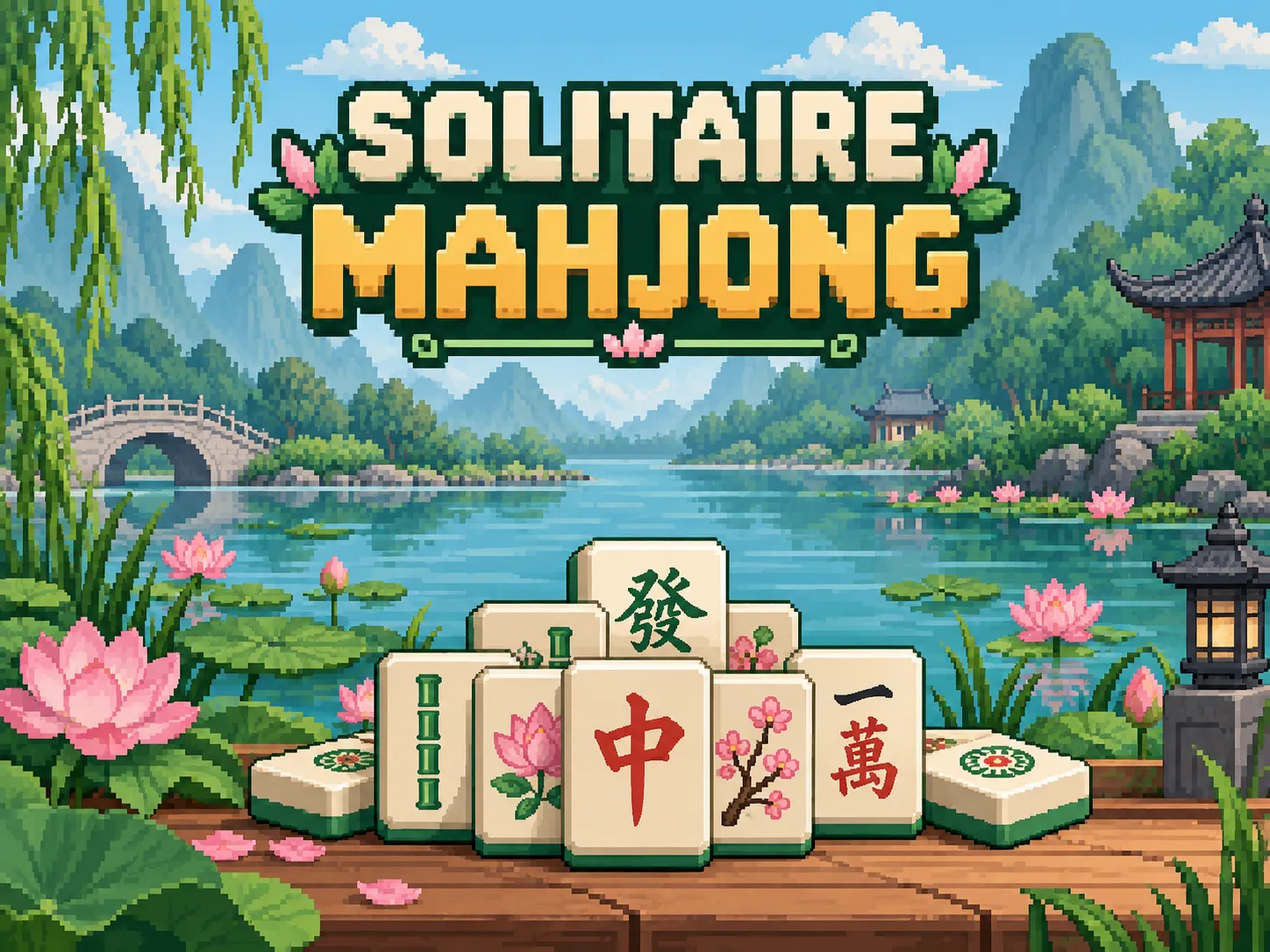
Mahjong Solitaire is a single-player matching puzzle played with the tiles of Mahjong, and it is worth saying plainly at the start: it is not the four-player game. There are no hands, no draws from a wall, no melds, and nobody to play against. You are given 144 tiles stacked into a shape and you take them off two at a time.
The shape is almost always the turtle, sometimes sold as Shanghai: 144 tiles over five layers, fifteen tiles wide, with a single tile capping the pile and three sticking out as a head and tail. Only some of those tiles can be touched at any moment, and the whole game is the question of which.
A tile is free when nothing is resting on top of it and at least one of its long sides — left or right — has nothing beside it. Take two free tiles that match and they leave the board, which frees whatever they were blocking. Clear all 144 and you have won. Run out of matching free pairs with tiles still standing and the board is stuck.
On Opka every deal is generated by laying matched pairs onto free positions until the board is full, which means each board is guaranteed to have at least one complete solution. That does not make it easy: you can still take the wrong pair and strand yourself, which is why undo is unlimited.
The free-tile rule, which is the whole game
A tile can be taken only when it is free, and free means two things at once. Nothing may be sitting on top of it — not partly on top, not overlapping a corner — and one of its two long sides must be open, so it could slide out sideways without disturbing anything.
Both conditions matter and beginners usually miss the second one. A tile in the middle of a long row on the bottom layer is completely uncovered and still unplayable, because it is walled in on the left and the right. It becomes free the moment either neighbour leaves, whichever side that is.
Short ends and edges are therefore where the game happens. The tile capping the turtle is always free at the start because nothing can be above it and nothing can be beside it, and taking it opens the four beneath.
- Free = nothing on top, and the left or right side clear.
- An uncovered tile hemmed in on both sides is not free.
- Only long sides count — a tile above or below does not block.
What matches what
The set is thirty-six groups of four tiles: nine circles, nine characters and nine bamboo, plus four winds, three dragons, four seasons and four flowers. That is 144 tiles, which is exactly what the turtle holds.
For all but two groups, matching is what you would expect — two tiles pair when they show the same face. The five of circles goes with the other five of circles; it does not go with the six.
The seasons and the flowers are the exception, and they are the rule most worth learning. Each of those groups holds four different pictures, and any two of them match. Spring pairs with Winter. Plum pairs with Bamboo. What they will not do is cross over: a season never matches a flower, because they are separate groups.
- Suits, winds and dragons match on an identical face.
- Any two seasons match each other; any two flowers match each other.
- A season never matches a flower.
How to not get stuck
Because the board is dealt solvable, being stuck is information: it means an earlier pair was the wrong one. The usual culprit is taking a pair off the top of the pile when the same pair was also available at the edge, or clearing two tiles of a group and leaving its other two buried in the same column.
So the habit worth building is to look before taking. When a group has three or four free tiles at once, think about which two to take rather than taking the first two you see — the choice decides what is left later.
Work down rather than across where you can. Tiles high on the pile block the most, and the layers underneath cannot be read until they are gone. Clearing the cap and the upper layers early turns a blind board into a visible one.
- Stuck means a wrong pair earlier, not a bad deal.
- With three or four of a group free, choose which two to take.
- Clear high tiles first — they hide and block the most.
How this differs from card solitaire
Klondike and its relatives hide information: cards sit face down and the game is partly about what you have not seen yet. Mahjong Solitaire hides almost nothing — every tile face is visible from the first moment. What it hides is access.
That makes it a puzzle of order rather than luck. You are not hoping for the right card to turn up; you are working out the sequence in which the tiles in front of you can legally be removed.
It also means a mistake looks different. In Klondike a game can be unwinnable from the deal. Here the deal is winnable and the mistake is yours, which is either reassuring or annoying depending on the day.